Research · AI search visibility and GEO
AI visibility score: what it measures, hides, and cannot prove
Learn how AI visibility scores are built, why tools disagree, and which prompt, citation, and traffic evidence to inspect before acting on a score change.
Climer team · August 11, 2026 · 8 min read
An AI visibility score summarizes a vendor's sampled prompts, provider coverage, mentions, citations, and weighting. Use it to spot movement, then inspect the underlying evidence before you claim stronger discovery, source preference, or business impact.
Free checkers and vendor landing pages dominate the live results for ai visibility score. As of August 19, 2026, Semrush, SEO Review Tools, Amplitude, Ahrefs, and other tools lead the US sample behind this brief. Their pages offer a score before they explain much about its denominator. For the broader operating model, read Generative engine optimization: a practical operating model for AI answers.
This guide treats the score as a measurement artifact and shows you how to inspect it.
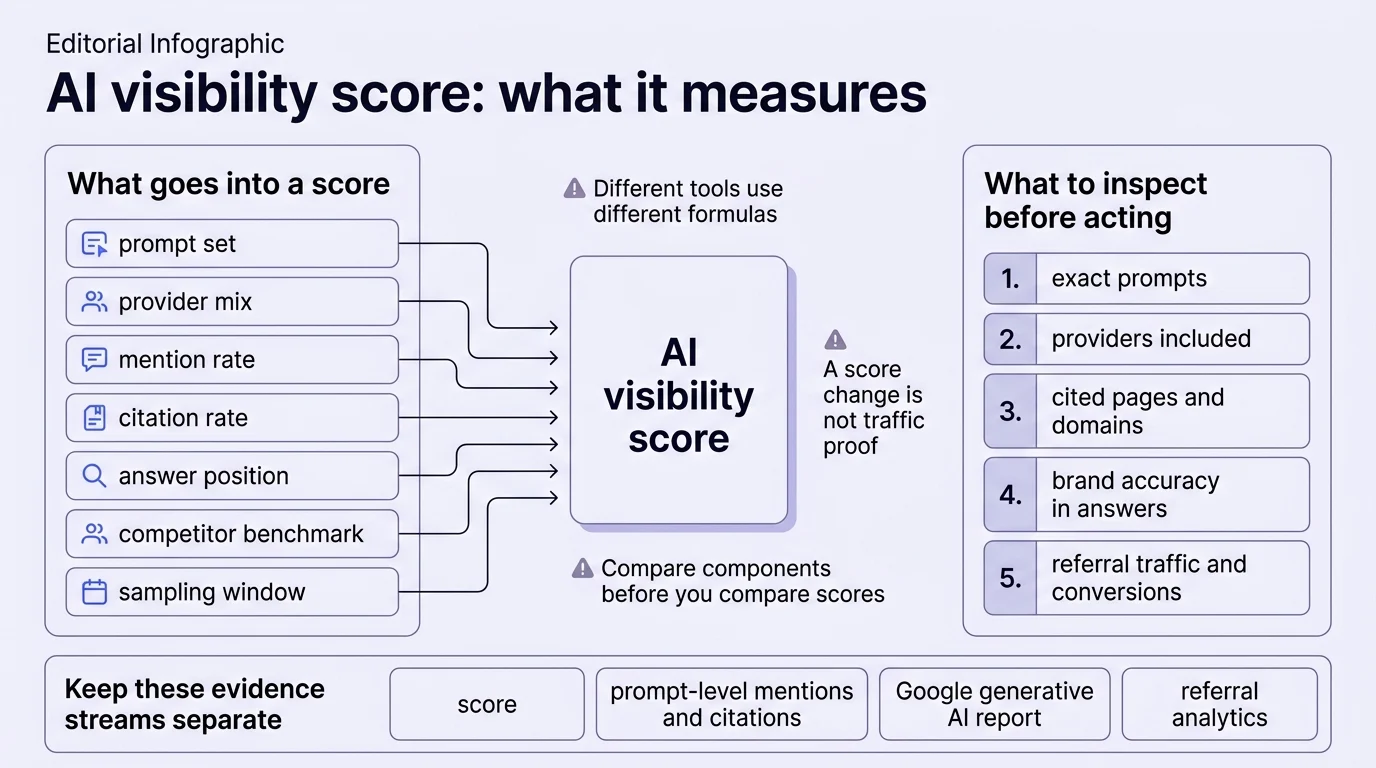
AI visibility scores compress several inputs#
One number can hide seven moving parts:
| Hidden input | What to ask for | Why it matters |
|---|---|---|
| Prompt set | Which prompts did the tool test, in which country or language, and why | A score built from branded prompts tells a different story from one built from category comparisons |
| Provider mix | Which engines did the tool include: ChatGPT, Gemini, AI Overviews, AI Mode, Perplexity, Copilot, or Claude | Coverage changes the numerator and the baseline |
| Mention rate | In how many sampled answers your brand appeared at all | Records presence without source attribution |
| Citation rate | Number of answers that cited your domain or page | Citation is often closer to source value than mention count |
| Position or share of answer | Whether your brand appears first, later, or as a passing mention | A prominence weight can change how two tools count the same answer |
| Competitor benchmark | Which competitors define the benchmark and how the vendor selects them | A changed comparison set can move the score |
| Sampling window | Whether the tool reports a daily run, a 30-day trend, a 90-day window, or monthly refreshes | Short windows swing more; long windows smooth volatility |
A score can flag a change. It makes a poor standalone KPI because each input can move the number.
Vendors define "score" in different ways#
The vendors publish definitions that show the differences.
As of August 19, 2026, Semrush says its AI Visibility Score is a 0 to 100 benchmark that compares a brand's mention frequency with the median for top industry competitors. Its free checker includes mentions, citations, cited pages, audience estimates, and coverage across ChatGPT, Gemini, AI Mode, and AI Overviews. Semrush provides a competitor-relative benchmark rather than a market census.
Ahrefs uses another model. Its July 13, 2026 help documentation says Brand Radar tracks brands across more than 405 million search-backed prompts. Its February 26, 2026 methodology post says Ahrefs expands the prompt set with People Also Ask data and semantic fanout, updates it each month, and reports on a 90-day window. Ahrefs says AI share of voice and estimated impressions model potential visibility rather than audience reach.
Searchable exposes a third recipe. Its visibility-tracking docs say its 0 to 100 Visibility Score reflects mention frequency, position in responses, context quality, and sentiment across tracked prompts and platforms.
Two tools can measure the same brand on the same day and produce valid but different scores because they use different inputs.
Cross-tool score comparisons fail on mismatched inputs#
A score of 60 cannot travel between a competitor benchmark, a position-and-sentiment model, and a share-of-voice model built from a large prompt corpus.
Use this test before you compare any AI visibility scores:
- Do the tools use the same prompt set?
- Do they cover the same providers?
- Do they use the same time window?
- Is the benchmark relative to competitors, or absolute within the sampled prompts?
- Does the report split mentions and citations or merge them into one score?
- Does the score weight prominence, sentiment, or context quality?
If any answer is "no" or "unknown," compare the components instead of the final scores.
The same rule applies within one tool. Ahrefs says it builds its global prompt corpus from search data and refreshes the corpus on a schedule. Semrush says its reports gather common queries and run them through LLMs. Searchable says tracked prompts feed presence, share, and score reporting. A change to prompt coverage, provider support, benchmark logic, or refresh cadence can move the headline number.
Inspect the parts behind each score change#
A score change starts an investigation.
Check the inputs in order:
- Check whether the prompt set changed.
- Check whether provider coverage changed.
- Check whether the benchmark set changed.
- Inspect the prompts that added or lost mentions.
- Separate mentions from direct citations.
- Review whether the cited pages are your pages, third-party pages, or both.
- Check the brand description for factual accuracy.
- Look for referral traffic or lead impact after the source checks.
Vendors change prompt sets, platform coverage, benchmarks, and reporting windows. Record those details with each score so you do not overread a method change as market movement.
A worked example#
A score report should lead you to a specific question about sampled answers.
Suppose your score rises across two reporting windows. Inspect one prompt family before you call the increase progress:
| Prompt family | Provider | Brand mentioned | Brand cited | Position in answer | What changed |
|---|---|---|---|---|---|
| "best payroll software for contractors" | ChatGPT | Yes | No | Listed late | Mention improved, but your site is not the source |
| "best payroll software for contractors" | Gemini | Yes | Yes | Listed with supporting link | Citation improved on one commercial page |
| "best payroll software for contractors" | Google AI Overview | No | No | Absent | Google visibility did not move on this query |
The example shows stronger provider coverage for one prompt family and a possible citation gain for one page in Gemini. You still lack evidence of a market-wide gain, a Google gain, or a change in traffic and pipeline.
Use the score to find prompt-level evidence that your team can inspect.
Keep score, citations, and traffic in separate columns#
Google's July 10, 2026 AI optimization guide defines measurement limits. It recommends the Generative AI performance report in Search Console for Google's generative features and warns that third-party tools lack access to Google's internal ranking or AI systems. Google Analytics added an AI Assistant channel on May 13, 2026 for traffic from recognized AI assistants. OpenAI's publishers FAQ, updated in late July 2026, says ChatGPT search referrals include utm_source=chatgpt.com.
Each source covers a separate evidence stream:
| Evidence stream | What it answers | What it does not answer |
|---|---|---|
| AI visibility score | Did the sampled benchmark move inside this tool's method | Why it moved, whether the score is comparable elsewhere, or whether revenue changed |
| Prompt-level mentions and citations | Which answers included your brand and which pages or domains they cited | Whether users clicked or converted |
| Google Search Console generative AI report | How your content performed in Google's generative features | Cross-provider visibility |
| Referral analytics | Which AI assistants sent visits, engaged sessions, and assisted conversions | Whether visibility was broader than the observed clicks |
Separate columns show whether you face absence, weak citation quality, inaccurate brand framing, or low referral value from answers that mention you.
A useful AI visibility report exposes its inputs#
Ask for the report behind any headline number.
A decision-ready report should expose:
- the exact prompt set or topic families;
- countries or languages tested;
- providers included;
- reporting window and refresh cadence;
- the vendor's definition of a mention;
- the vendor's definition of a citation;
- whether prominence or sentiment affects the score;
- benchmark competitors and the selection method; and
- prompt-level examples of wins, losses, and cited pages.
A score without those inputs cannot support a content or budget decision.
Turn a score report into decisions#
The underlying evidence points to four common decisions:
| What you find | Decision to consider |
|---|---|
| Mentions rise but citations stay flat | Improve the page or asset that should earn the citation |
| Citations rise on the wrong page | Clarify the canonical owner and strengthen the page that should answer the job |
| One provider improves while others stall | Review provider-specific prompt families before making broad claims |
| Score drops while referrals and citations stay stable | Check methodology, coverage, and benchmark changes before rewriting content |
A small business needs enough structure to choose content work, source correction, entity cleanup, or no action. A universal score cannot make that choice.
Climer's role#
Climer keeps sampled prompts, mentions, citations, and outcome evidence visible. A summary score can help teams scan a report, while the underlying evidence lets them review what changed and choose a response.
Treat an AI visibility score as an index into prompt-level evidence. The evidence, not the shortcut, supports the decision.