Guide · AI search visibility and GEO
Generative engine optimization: a practical operating model for AI answers
Learn what generative engine optimization means, how publishers earn AI answer visibility, and how to measure prompts, citations, and traffic in separate evidence streams.
Climer team · August 10, 2026 · 11 min read
Generative engine optimization makes your company a usable, credible source for AI-generated answers and measures where that source appears. The answer engine retains control over selection.
For a small or mid-sized business, crawlable pages need to answer real questions with evidence an answer engine can reuse. A recurring measurement loop then keeps prompts, mentions, citations, Google visibility, and referral traffic in separate columns.
For the connection between classic search and AI answer visibility, read SEO and GEO Are One Visibility System. This guide covers the GEO operating model.
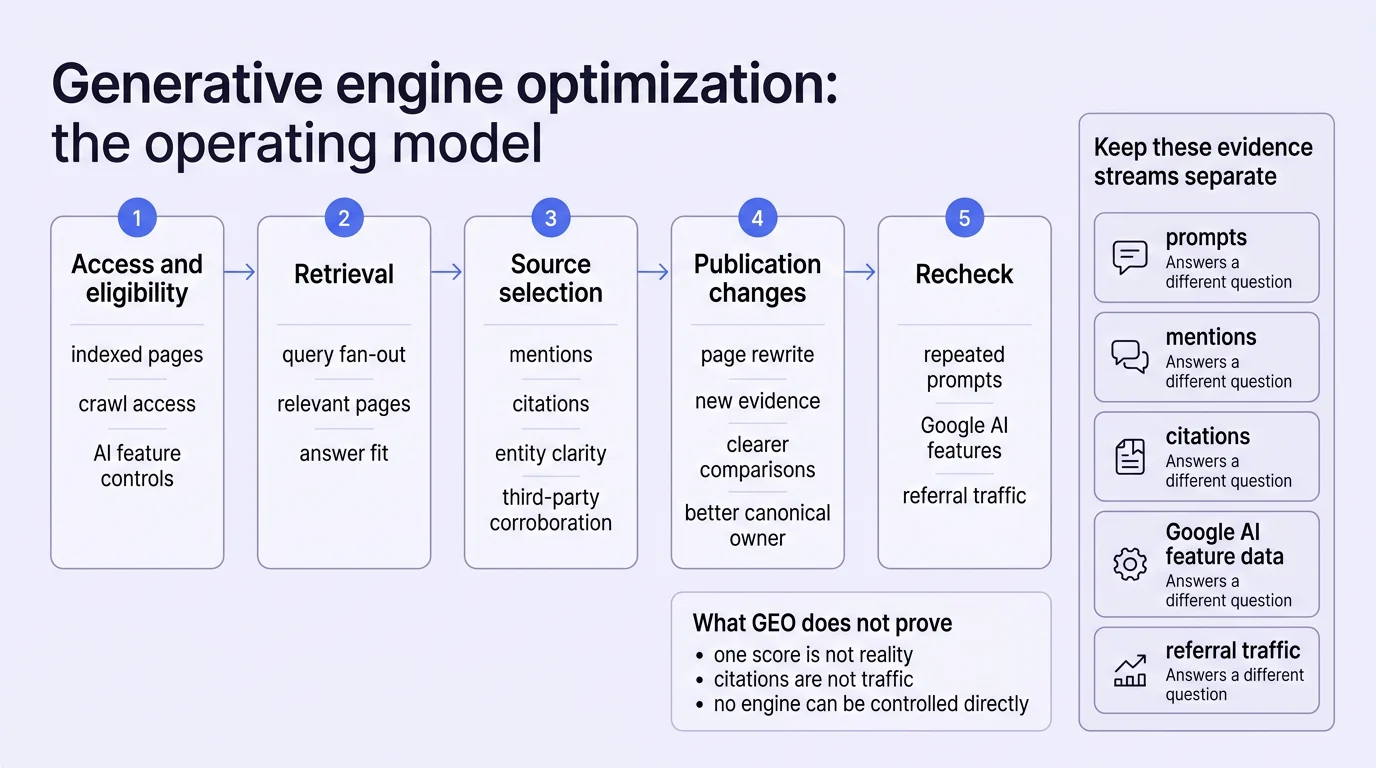
Generative engine optimization is an operating model#
The market applies the term to different methods. The 2024 paper GEO: Generative Engine Optimization introduced GEO as a framework for improving visibility in generative engine responses and reported gains of up to 40% within its benchmark setting. A July 2026 critical survey of 45 studies, Optimizing Visibility in Generative Engines, describes a pipeline that publishers can observe in part. No single ranking signal or repeatable trick explains it.
As of August 19, 2026, a Google AI Overview and definition-led guides from Google, Coursera, Semrush, and other publishers dominate the live results for generative engine optimization. Searchers want a plain-language definition and work they can start next week.
Use this division of responsibilities:
- SEO still provides the foundation.
- GEO adds answer-surface measurement, source-worthiness, and cross-provider testing.
- Each answer engine retains control over its output.
Google's position covers fewer new controls than many vendor pitches. In its AI optimization guide, published May 15, 2026, Google applies established SEO practices to generative AI search. Google considers optimization for its generative AI features part of SEO. GEO remains a useful operating label for cross-provider measurement and source work.
Four checkpoints connect a page to an answer#
Answer engines use different systems, yet publishers face four recurring checkpoints.
1. Access and eligibility#
The engine needs a path to your content. For Google AI features, Google must index a page and allow it to show a Search snippet before it can appear in AI Overviews or AI Mode. OpenAI says in its crawler documentation that ChatGPT search features use OAI-SearchBot to surface websites. Perplexity publishes controls for PerplexityBot in its crawler documentation.
Check crawlability first. Blocked pages, noindex directives, weak rendering, or feature exclusions can end the path before retrieval.
2. Retrieval#
Google's AI optimization guide describes retrieval-augmented generation and query fan-out. An answer system may break one user prompt into related subqueries, retrieve several pages, and ground the response in that set.
A page must support the keyword and its neighboring questions, comparisons, and evidence needs.
3. Source selection and synthesis#
After retrieval, the system decides whether it can use your information inside the answer. Factual density, direct definitions, clear comparisons, entity consistency, and supporting evidence shape that choice.
The 2025 University of Toronto paper, Generative Engine Optimization: How to Dominate AI Search, found large differences between AI search systems in source mix, freshness, language stability, and sensitivity to phrasing. The paper also found a strong bias toward earned media, meaning authoritative third-party sources, over brand-owned and social sources. Your website and the surrounding evidence support each other.
4. Presentation and click behavior#
Answer presence can produce no traffic. A system may mention a brand without a link, cite a source in a low-visibility position, or satisfy the user before a click.
Track referral traffic apart from citations so you can see which answer surfaces produce commercial visits.
The evidence streams that matter#
Many dashboards flatten GEO into one score and conceal the evidence behind the next decision.
Use separate evidence streams.
| Evidence stream | What to record | What it tells you | What it cannot prove |
|---|---|---|---|
| Prompt set | The exact prompts, provider, country or language, date, and sampling method | What you tested | Market-wide visibility |
| Mentions | Whether the answer named your brand or page | Brand presence in sampled answers | Accuracy, prominence, or traffic |
| Citations | Which URLs the answer linked or cited | Source attribution and eligible pages | Business impact on its own |
| Google AI feature data | Search Console generative AI impressions and clicks where available | Google AI feature performance | Cross-provider visibility |
| Referral traffic | Sessions, landing pages, engaged visits, assisted conversions | Whether answer surfaces are sending visits | Why a mention or citation changed |
Two platform details help with measurement:
- Google Search Console now has a generative AI performance report for Google Search features. The report covers Google.
- OpenAI says in its publishers and developers FAQ that ChatGPT search referrals include
utm_source=chatgpt.com, and Google Analytics added anAI Assistantchannel in May 2026 for recognized AI assistant referrers in its product updates. Both are helpful for traffic measurement, but neither turns referral traffic into a full visibility census.
Prompts, citations, and referrals capture related but distinct events. Keep all three available for review.
A recurring GEO loop for SMB teams#
SMB teams can run GEO through a repeatable loop inside their content process.
1. Choose a narrow prompt set#
Start with prompt families tied to real commercial or educational jobs:
- category definition prompts;
- comparison prompts;
- local or problem-based prompts; and
- brand-inclusion prompts tied to a clear reason for your company to appear.
Keep the set stable across several measurement periods. Change it when you widen the scope and record the change.
2. Inspect current citations#
For each prompt, record:
- whether the answer mentions your brand;
- whether the answer cites your site;
- which pages the answer cites;
- which competitor or third-party domains the answer cites instead; and
- whether the answer is accurate about your company.
The cited source may reveal an unexpected bottleneck. An engine may prefer a comparison page, documentation, a local listing, a review site, or an industry article.
3. Diagnose the gap before writing#
Look for the first real bottleneck:
- no eligible page exists;
- the page exists but answers the wrong question;
- the page is thin or generic;
- the page lacks concrete evidence;
- the company entity is inconsistent across the web; or
- third-party corroboration is missing.
A diagnosis ties the next content change to an observed gap.
4. Publish one complete intervention#
A credible intervention resolves one observed gap. Examples include:
- rewriting a product or service page so a supported answer appears near the top;
- adding original pricing, process, benchmark, or methodology detail;
- building a comparison that resolves a real buyer question;
- improving entity clarity across the site and business profiles; or
- creating a better canonical page for a prompt family you already see in tests.
The page should help a human reader first. Google's May 2026 guidance calls for unique, non-commodity content. Its mythbusting section says Google AI search does not require llms.txt, micro-chunked pages, or rewrites made for AI systems alone.
5. Recheck across a fixed window#
Re-test across:
- multiple runs;
- representative paraphrases;
- the providers you care about; and
- a window long enough to observe Google and referral movement in separate reports.
The 2026 GEO survey states a key limit: researchers have not established a stable, longitudinal, cross-platform causal method for durable discovery or downstream business outcomes. Preserve that uncertainty in each measurement window.
Build source-worthy pages#
Pages earn citations when readers and systems can trust the evidence, extract a complete answer, and compare the claim with alternatives.
Clear answer ownership#
Each page should own a distinct job. If one page tries to define the category, sell the product, compare vendors, and answer support questions at once, answer engines have more ways to prefer another source.
Self-contained answers#
Lead with the answer, then support it. A precise claim, definition, or comparison gives the system a complete passage before setup paragraphs get in the way.
Verifiable evidence#
Add the kind of support a person would need to trust the answer:
- named methodology;
- dates for current product or policy claims;
- original examples;
- data with traceable sources; and
- honest limits where evidence is missing.
Commentators cite the 2024 GEO paper as proof that citation-friendly structure wins. The paper's benchmark shows that structure can help after retrieval. Topic relevance and authority still influence whether a source enters the set.
Entity clarity#
Make sure your company, product names, category, location, and primary claims stay consistent across your own site and major third-party references. This supports both retrieval and answer accuracy.
Useful supporting formats#
Google's current AI search guidance calls out product data, local business details, images, and video as visibility inputs. A local service page, product page, or how-to guide should expose the formats the query calls for.
Use third-party sources to corroborate owned pages#
Your website holds the facts you control. Credible third-party sources corroborate those facts for answer engines and buyers.
Use owned pages to control answer quality, the factual record, and the landing experience. Third-party sources help answer engines validate that record and compare you with alternatives.
SMB teams can divide the work as follows:
- keep core commercial and educational pages strong on your own site;
- earn citations from credible publications, directories, associations, review platforms, or community discussions where your buyer would expect to find you; and
- avoid buying low-trust mentions or manufacturing superficial discussion volume.
Google's current guidance warns against chasing inauthentic mentions. The 2025 GEO paper supports authoritative earned media as a source signal. Manufactured chatter cannot supply the same credibility.
Set boundaries for GEO claims#
GEO can improve eligibility and source quality, then measure sampled outcomes. It cannot guarantee inclusion or prove business impact from one mention. One vendor score covers one methodology, and each provider requires its own observations. Classic SEO, content strategy, and product page quality remain part of the work.
Programs lose credibility when they present a compressed score as outcome proof. Keep the evidence streams separate, tie each content change to a clear hypothesis, and measure again.
Climer's role#
Climer monitors AI-answer visibility, keeps Google and AI evidence separate, and uses observed gaps as an input to content decisions that teams can review. The product turns those steps into a recurring content loop.
Answer engines retain control over inclusion, and Climer does not claim one causal score across providers. It keeps the prompt, cited source, page change, and subsequent observation available for inspection.
Related guides#
- AI visibility score: what it measures, hides, and cannot prove: Learn how to read prompt coverage, mentions, citations, weighting, and score changes without mistaking a dashboard score for business impact.
- ChatGPT SEO: what publishers can influence: See which discovery, citation, and measurement inputs publishers can influence in ChatGPT search without claiming access to a hidden ranking system.
- LLM SEO: controllable work, weak signals, and false promises: See what changes across Google, ChatGPT, Perplexity, and other assistant surfaces, which inputs publishers can influence, and which popular tactics still lack evidence.
- AI search referral traffic: how to measure visits without overstating attribution: Separate observable assistant-sourced visits from mentions and citations, then judge landing pages, engagement, assisted journeys, and conversions with incomplete attribution in mind.
- Answer engine optimization: how to design content for direct answers: Understand how answer extraction changes page structure, supporting context, schema expectations, and measurement.
- AI search engine optimization: a practical implementation playbook: Follow the execution sequence for indexing, answer-fit, evidence, entity clarity, third-party corroboration, and rechecks across AI-assisted search.
- Best AI visibility tools: compare evidence, coverage, and limits: Compare the leading monitoring options by prompt model, provider coverage, refresh cadence, exports, pricing, and best-fit team.
- AI Overviews in search: what changes for visibility, citations, and clicks: Understand how Google AI Overviews change result composition, source exposure, click risk, and what Search Console can and cannot isolate.
- Ranking in AI Overviews: a guide to citation eligibility: Improve citation eligibility with Google-specific checks for indexing, snippet access, answer structure, evidence, and measurement limits.
Generative engine optimization should help your team produce better source material, test the relevant answer surfaces, and report the result with its limits intact. The operating model can endure as platforms change.