Guide · AI search visibility and GEO
AI Overviews in search: what changes for visibility, citations, and clicks
Learn what Google AI Overviews are, how they differ from AI Mode, and what they change about source exposure, click behavior, and Search Console measurement.
Climer team · August 14, 2026 · 7 min read
AI Overviews are Google's AI-generated summaries inside Search results. Google places an answer and its sources before some classic organic results, so the summary can absorb attention that once went to blue links.
Site owners need to know when Google shows AI Overviews, how cited links work, and which changes they can measure. For the broader operating model, read Generative engine optimization: a practical operating model for AI answers.
As of August 19, 2026, Google's help and product pages lead the live US results for ai overviews in search, followed by general explainers. Searchers want a definition, a comparison with AI Mode, and a clear account of source exposure and click risk.
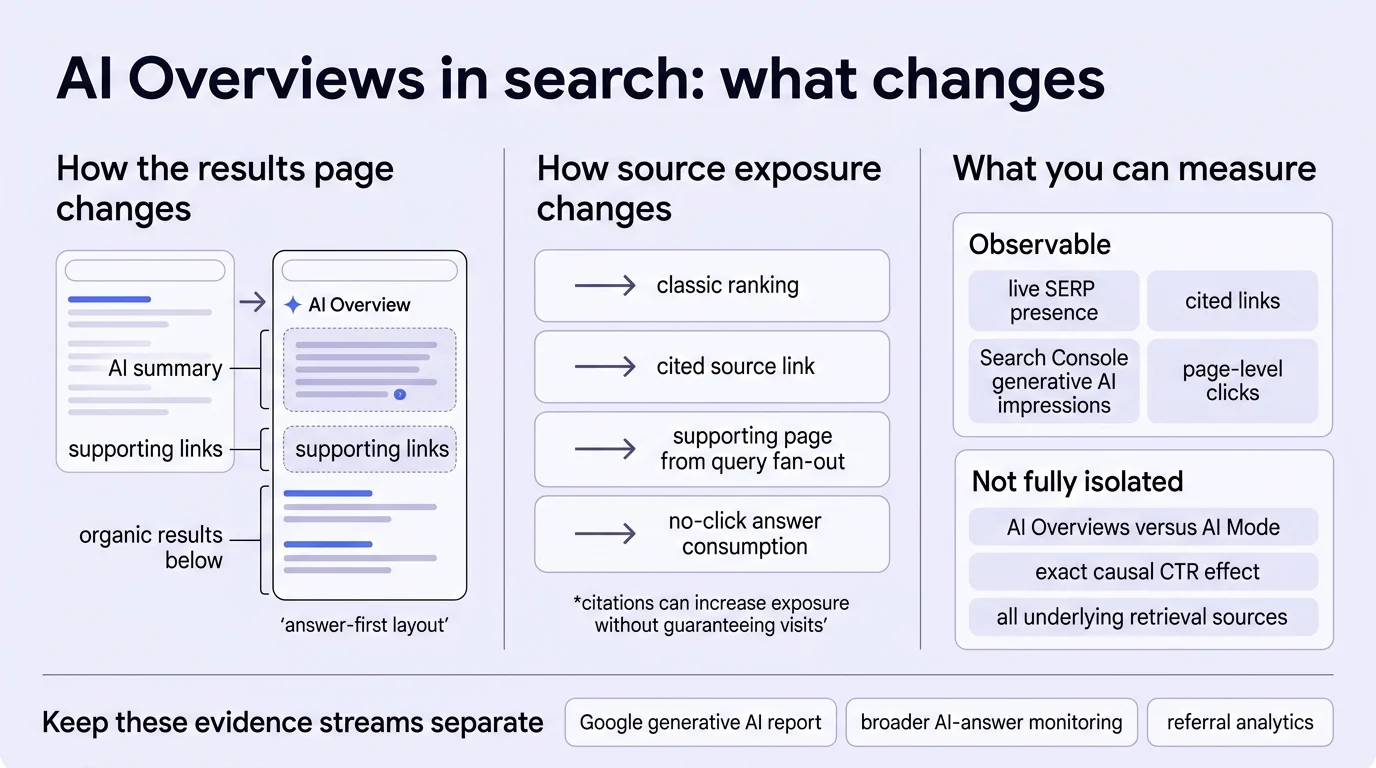
AI Overviews sit inside Google Search#
Google's current AI Overviews help documentation describes an AI-generated snapshot with key information and links. Its Search Central documentation places AI Overviews and AI Mode inside Google Search and applies the same core SEO and technical requirements to both.
The feature has three defining traits:
- Google shows the summaries inside standard Search results when it expects them to help.
- They can cite and link to web pages that support the response.
- Google's main Search index and ranking systems still supply the foundation.
Google says it designed AI Overviews for queries where a summary adds value beyond a standard results page. You will see uneven coverage: one query family may trigger the feature often while another seldom does, and location, device, account, or product experiments can change the result.
AI Overviews differ from AI Mode#
The label "Google AI search" hides two surfaces with different user experiences.
The differences affect publishers as follows:
| Surface | What the user sees | How it behaves | What it means for a publisher |
|---|---|---|---|
| Classic search | A standard results page with ranked listings and other SERP features | The visible result set shapes click behavior | Ranking and snippet quality remain the main visibility questions |
| AI Overviews | Google inserts an AI summary with supporting links into the results page | Google may synthesize an answer before the user chooses a result | Google can cite a source even when the user never reaches the classic blue link |
| AI Mode | A conversational AI search experience with follow-up questions and links | Google says it expands AI Overviews with more advanced reasoning | Track its traffic and citations apart from AI Overviews |
Google's AI Mode help page says AI Mode adds advanced reasoning and interaction to AI Overviews. It can break a question into subtopics and search for each one at the same time. Google's AI features documentation says both surfaces can use query fan-out, which issues several related searches while Google constructs a response.
Measure the surfaces apart. AI Overviews appear on a familiar results page, while AI Mode invites follow-up questions. A single "Google AI" number conceals that distinction.
AI Overviews reshape the results page#
The answer can come before the ranking decision#
On a classic SERP, you choose a result to get an answer. With AI Overviews, Google can answer part of the question first. Organic results then compete with a synthesized response at the top.
Links support the answer and offer a destination#
Google says AI Overviews surface relevant links for further reading. Google may expose a page as a supporting source even when another page owns the first visible organic listing. Presence on the results page no longer guarantees a click.
Query fan-out widens the source set behind one prompt#
Google's AI features can issue related searches across subtopics and data sources while building a response. Your page may compete on neighboring questions and supporting details beyond the keyword in the search bar.
That retrieval process makes citations harder to predict with rank tracking. Google can use a page for one part of an answer even when an SEO would not expect it to rank first for the original query.
Reusable pages can earn source exposure#
A page can appear in three places:
- as a normal organic result below the summary;
- as one of the cited or linked sources supporting the summary; and
- in the larger evidence set Google retrieved, even if publishers cannot observe that role.
Publishers can observe the first two.
Google's Search Central documentation says AI features can display a wider set of helpful links than classic search. A site may gain exposure by covering a specific subtopic well, even if stronger domains dominate the query family.
A citation may improve brand recognition or perceived credibility. It cannot guarantee a click.
Expect click risk to vary by query#
Current primary-source evidence connects AI Overviews with fewer outbound clicks on the queries where they appear. Agarwal and Sen's 2026 field experiment, a two-week US study with more than 1,000 participants, found that AI-generated summaries cut organic clicks by about 39.8% and increased zero-click searches by about 34.5%. Participants reported no gain in satisfaction. A separate 2026 study of English Wikipedia traffic attributed a 15% decline to AI Overview exposure.
Those studies cannot supply a CTR formula for your site:
- the field experiment measures average behavior across sampled users, not your exact query mix;
- the Wikipedia study measures one publisher type with a strong informational footprint;
- query intent can change click behavior; and
- analyze AI Mode, AI Overviews, classic featured snippets, and other SERP features as distinct surfaces.
AI Overviews raise click risk on informational queries when the summary satisfies the searcher. A CTR decline still needs query-level evidence before you attribute it to the feature.
Search Console combines Google's generative surfaces#
The current Search Console help page says the Generative AI performance report remains in rollout and includes impressions from AI Overviews and AI Mode. You can group the report by page, country, and date.
Use the report with three rules:
1. Treat the report as evidence from Google#
The report is about Google's generative AI features in Search. It does not tell you what happened in ChatGPT, Perplexity, Claude, or any other answer surface.
2. Do not isolate AI Overviews without extra evidence#
Google's public help documentation describes no dimension for AI Overviews on their own. A claim such as "AI Overviews drove this exact click change" remains an inference unless you have controlled evidence.
3. Keep page-level and property-level logic separate#
Google notes that aggregation can produce different chart and table totals. Search Console also assigns most page data to canonical URLs. Both details aid diagnosis but cannot establish that one SERP feature caused a change.
Use Search Console to measure visibility and clicks from Google's generative features. Inspect live SERPs before you attribute a movement to AI Overviews.
Inspect AI Overviews with a repeatable method#
Run the same checks for each query family:
- Search the query family live and record whether an AI Overview appears.
- Note which pages Google cites and how visible those links are.
- Check whether the cited sources are commercial pages, editorial explainers, forums, or documentation.
- Compare that with the classic organic results below the summary.
- Review Google's generative AI report in Search Console for the affected pages.
- Keep any Google findings separate from broader AI-answer monitoring.
This record shows what changed on the page, where your site appeared, and how much of the change you can observe.
For optimization steps, read Ranking in AI Overviews: a guide to citation eligibility.
Climer's role#
Climer monitors AI-answer visibility, keeps Google and broader AI evidence separate, and uses observed gaps as an input to content decisions that you can review. Publisher tools provide a limited view of a volatile, query-dependent feature.
Keep each evidence stream in its own report:
- live SERP inspection for feature presence and cited sources;
- Search Console for Google's own generative AI visibility and clicks; and
- broader AI-answer monitoring for cross-platform mentions and citations.
AI Overviews change source exposure and expected click behavior. Track when Google answers first, which sources it shows, and which claims your measurement tools can support.