Guide · AI search visibility and GEO
Ranking in AI Overviews: a guide to citation eligibility
Learn which Google-documented actions improve eligibility for AI Overviews, what remains outside your control, and how to measure citations, rankings, and visits without blending them together.
Climer team · August 15, 2026 · 9 min read
Google selects sources for AI Overviews through a different process from blue-link ranking. Make one page easy to index, show with a snippet, reuse as a direct answer, and trust within a wider evidence set. Google then decides whether to show an AI Overview and which sources to cite.
For the wider operating model, read Generative engine optimization: a practical operating model for AI answers. For the feature mechanics, read AI Overviews in search: what changes for visibility, citations, and clicks.
As of August 19, 2026, step-by-step guides from SEO vendors and Google's documentation dominate the live results for how to rank in ai overviews. Searchers want a bounded checklist that improves eligibility while accounting for an AI Overview position that can change between runs.
Start with the rule Google has already published#
Google's current AI features and your website documentation requires Google to index a page and allow it to appear with a Search snippet before it can serve as a supporting link in AI Overviews or AI Mode. Its AI optimization guide, last updated July 10, 2026, applies the same core SEO and quality systems to generative AI features.
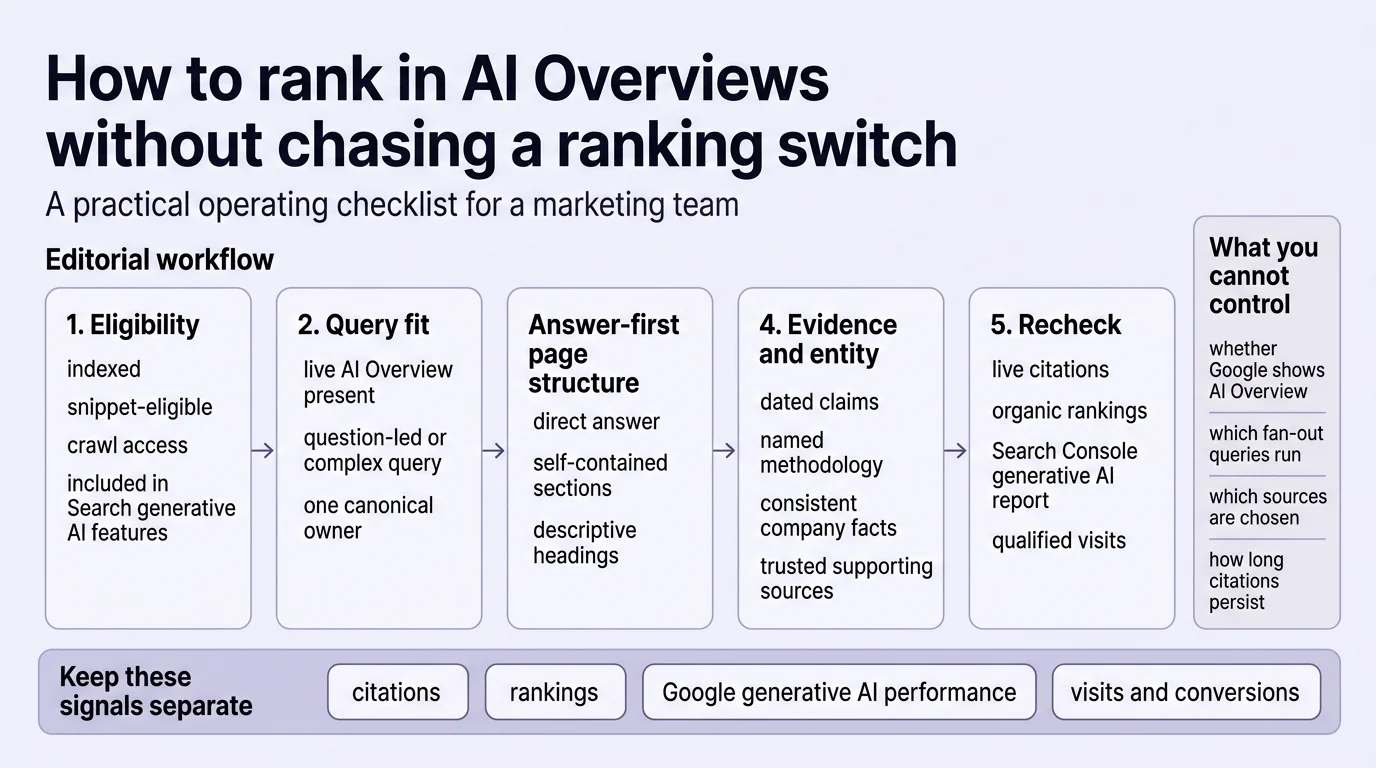
Work through four stages:
- Get the page eligible.
- Make the answer easy to reuse.
- Add evidence Google can trust.
- Measure the outcome before you claim causation.
Those stages improve citation eligibility. They cannot guarantee placement.
Step 1: confirm citation eligibility#
Verify that the target page can appear in Google's AI features before you rewrite it.
| Check | What to verify | Why it matters |
|---|---|---|
| Indexing | Google indexed the page and chose the intended canonical | Google cannot cite an unindexed page |
| Snippet eligibility | The page can appear with a snippet in Google Search | Google requires snippet eligibility for AI Overviews |
| Search generative AI control | Search Console includes the property in Search generative AI features | Exclusion prevents links or grounding |
| Crawl access | Googlebot can pass robots.txt, CDN rules, and rendering | Google must be able to access the content it may cite |
| Content visibility | Important answer text is present in crawlable HTML and not hidden behind interfaces | Hidden or delayed content is harder to reuse |
Snippet controls create an easy-to-miss gate. Google's snippet controls documentation and robots meta tag specification say nosnippet, data-nosnippet, and max-snippet affect AI Overview content. The nosnippet directive prevents Google from using the content as a direct input for AI Overviews and AI Mode. The max-snippet directive limits how much page text Google may use.
Snippet eligibility sets a hard gate. Restrictive preview controls can leave a page eligible for organic ranking but unsuitable for an AI Overview citation.
Step 2: inspect query families that trigger AI Overviews#
Check feature presence before you invest in a query family.
Google says its systems show AI Overviews when the feature adds value beyond classic Search. A May 2026 measurement study, Measuring Google AI Overviews, analyzed 55,393 trending US queries over 40 days. It found 13.7% activation across the sample and 64.7% activation for question-form queries. The gap shows an uneven trigger pattern; it does not justify a page for each question query.
Use the finding to set priorities:
- prioritize complex informational and question-led searches where Google is already showing AI Overviews;
- inspect the live SERP before deciding the page is an AI Overview candidate;
- avoid treating every keyword variant as a separate content opportunity; and
- keep query-trigger uncertainty separate from page-quality work.
Google's AI optimization guide warns against separate pages for each variation or fan-out query. Strengthen one canonical page that covers the searcher's job in full.
Step 3: make the answer extractable in the first screenful#
After you confirm eligibility, check whether Google can lift a useful answer from the page.
Google does not publish an "answer-first" ranking factor. Its description of retrieval and query fan-out supports a limited inference: a direct, self-contained answer requires less interpretation than one buried in a long introduction.
Structure the page as follows:
- answer each heading in the first paragraph;
- keep each section focused on one sub-question;
- use descriptive headings that mirror the decision sequence;
- make key definitions and claims stand on their own; and
- cut filler that delays the useful part of the page.
For this query, a weak section starts like this:
- "AI Overviews are changing search in many interesting ways..."
A stronger section starts like this:
- "To appear in AI Overviews, Google must index the page, allow a snippet, and find the content useful as supporting evidence."
Reduce the synthesis Google must do before it can use your page. Human readers benefit from the same direct structure.
Step 4: add evidence that makes the page worth citing#
Google's AI optimization guide emphasizes non-commodity content. Google can replace a generic summary with any equivalent page.
Strengthen the evidence through:
- named methodology if you recommend a process;
- dates on any product, policy, pricing, or feature claim;
- original examples that show the advice in use;
- comparisons with explicit criteria instead of broad praise; and
- clear limits where you do not have direct proof.
Focus the page on a specific Google result and the question it answers. Current, inspectable detail can make the page a trustworthy supporting source.
The May 2026 AIO measurement paper found that 29.8% of AIO-cited domains did not appear in the co-displayed first-page results for the same query. Ranking and citation selection overlap but follow different patterns. A high-ranking page may provide weak support, while Google may cite another page for one clear sub-point.
Step 5: tighten entity clarity and source consensus around the page#
Google's documentation says AI features can incorporate product information, local business details, images, and video. It points teams to Merchant Center and Business Profile when those sources apply.
Source consensus can support trust. Give Google matching business facts across the sources it reads.
Check for consistency across:
- the company name and category on your site;
- product, service, or location details on the target page;
- About, Contact, and policy pages;
- Merchant Center or Business Profile, if relevant;
- major directories, review profiles, and industry references; and
- internal links that clarify which page owns the topic.
AI Overview work overlaps with content governance. Competing pages, inconsistent categories, and conflicting claims make it harder for Google to identify a canonical source.
Step 6: match the page format to the query#
Google's guidance says generative AI features can use prose, images, video, local business information, and product details.
Use the query to decide what the page needs:
- A product query may need current specs, merchant data, and clear use cases.
- A local service query may need location signals, service-area clarity, and review evidence.
- A workflow query may need steps, edge cases, and visual support.
- A comparison query may need an explicit decision table.
Structured data supports this work when it matches the visible page and helps rich-result eligibility. Google requires no special schema for AI Overviews, and schema cannot serve as a shortcut to source selection.
Separate publisher controls from Google's controls#
| Publisher controls | Google controls |
|---|---|
| Indexing and snippet eligibility | Feature presence for a query |
| A direct, self-contained answer | Fan-out subqueries |
| Current, non-commodity evidence | Competing sources retrieved for a run |
| Consistent business facts and canonical signals | Citation visibility and persistence across experiments |
Treat "rank in AI Overviews" as work that increases citation eligibility for queries where the feature appears.
Ignore the tactics Google says do not matter#
Google's July 2026 AI optimization guide lists tactics publishers can stop chasing in Google Search:
llms.txtor other AI-only files;- artificial content chunking;
- rewrites aimed at AI systems alone;
- inauthentic web mentions; or
- special schema for AI Overviews.
The list brings the work back to page quality. Give documented eligibility, answer clarity, and evidence quality priority over unconfirmed tactics.
Measure before and after without blending the signals#
Track citations, rankings, and qualified visits as separate outputs because they answer different questions.
| Evidence stream | What to record | What it tells you | What it does not prove |
|---|---|---|---|
| Live SERP checks | Query, date, country, whether an AI Overview appeared, whether Google cited your page | Visible citations in sampled results | Site-wide visibility or business impact |
| Organic rankings | The page's ordinary ranking for the target query family | Whether classic search visibility improved or held | Why an AI Overview citation changed |
| Search Console generative AI report | Impressions and pages in Google's generative AI features | Google-only generative visibility | AI Overviews alone, because the report also includes AI Mode |
| Referral and on-site analytics | Visits, landing pages, engaged sessions, leads, assisted conversions | Whether AI-driven visibility produced useful traffic | Whether a citation caused the traffic lift by itself |
Use this before-and-after loop for one page:
- Save the pre-change SERP and note whether Google cites your page.
- Save the page's organic ranking and canonical URL state.
- Make one complete change set.
- Recheck the same queries on a fixed cadence.
- Review Search Console generative AI data apart from classic Search performance.
- Check whether the page earned qualified visits alongside raw impressions.
Google's Generative AI performance report includes AI Overviews and AI Mode, so it reports a combined Google surface. An August 5, 2026 paper on click behavior around AI Overviews found that cited-source clicks occurred in about 1% of AI Overview visits in a one-month panel of 900 U.S. adults. Report citation gains and traffic gains as separate outcomes.
If you want a framework for the monitoring side, use AI visibility score: what it measures, hides, and cannot prove.
Climer's role#
Climer monitors AI-answer visibility, keeps Google and AI evidence separate, and uses observed gaps as an input to content decisions that teams can review.
Google retains control over feature presence and citation. Climer keeps the operation focused on page choice, answer quality, consistent entity facts, and measurement across a fixed window.
Pick one page with a clear role in a question-led query family. Make it indexed, snippet-eligible, answer-first, and evidence-backed, then recheck the same SERPs before you expand the work.