Guide · AI search visibility and GEO
AI search engine optimization: a practical implementation playbook
Learn how to make your site more eligible, citable, and measurable across AI-assisted search while respecting the limits of publisher control.
Climer team · August 12, 2026 · 10 min read
AI search engine optimization extends search optimization. Your pages must serve as reusable sources inside answer systems as well as blue links on a results page.
The foundation remains familiar, but the implementation sequence changes. As of August 19, 2026, Google's documentation and implementation guides lead the live results for ai search engine optimization in the United States, United Kingdom, and Australia. Marketers want steps that make a site easier to retrieve, cite, and measure across AI-assisted search.
For the broader operating model, read Generative engine optimization: a practical operating model for AI answers. This guide covers the execution work that makes an indexable site worth citing.
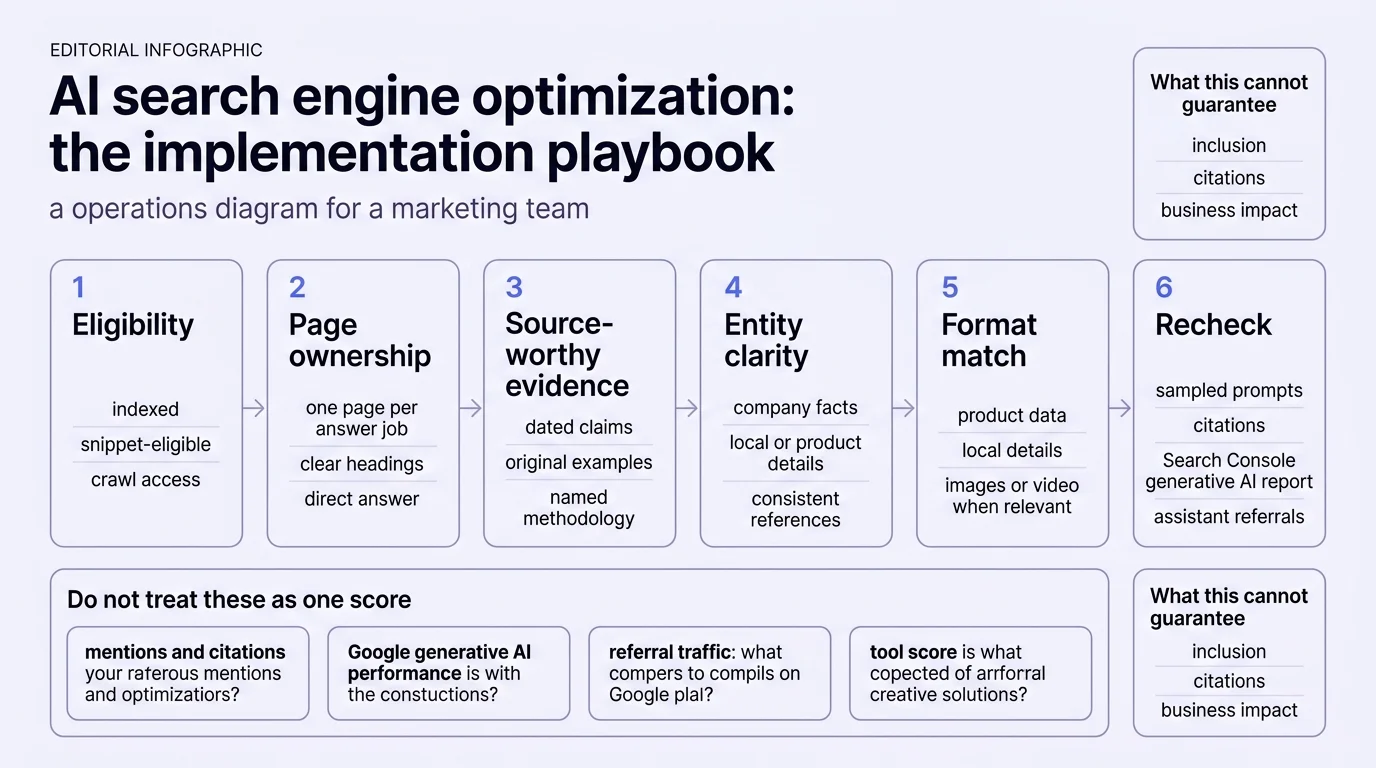
Improve source quality across the retrieval process#
Google's current guide to optimizing for generative AI features on Google Search, last updated July 10, 2026, applies established SEO practices to generative AI features because Google builds them on its core Search ranking and quality systems. The guide explains two mechanics:
- retrieval-augmented generation, where Google retrieves relevant pages from its index and uses them to ground a response;
- query fan-out, where one prompt can expand into several related searches before Google assembles the answer.
AI search optimization makes your content accessible, relevant, and trustworthy enough to survive retrieval and synthesis.
Cross-platform behavior varies. The September 2025 paper Generative Engine Optimization: How to Dominate AI Search found differences in freshness, language stability, phrasing sensitivity, and source mix across AI search systems. A July 2026 survey of 45 studies, Optimizing Visibility in Generative Engines, describes GEO as a stochastic pipeline whose workings publishers can observe in part. Those conditions call for a recurring operating loop instead of a one-time page rewrite.
Step 1: confirm that the important pages are eligible to appear#
Confirm eligibility before you test prompts.
Google's AI features documentation requires Google to index a page and allow it to appear with a snippet before the page can serve as a supporting link in AI Overviews or AI Mode. Google lists no extra technical requirements for those features.
Run four checks:
- Confirm that Google indexed the page.
- Allow the page to appear with a snippet.
- Expose important content to crawlers through dependable rendering and open resources.
- Resolve duplicates, redirect chains, and conflicting canonical signals.
Apply the same discipline beyond Google. OpenAI's crawler documentation says ChatGPT search features use OAI-SearchBot to surface sites. OpenAI recommends allowing the bot in robots.txt if you want your pages in ChatGPT search results. A blocked crawler makes the rest of the optimization work moot.
Crawler access, indexing, and canonicalization remain basic search operations work. The "AI SEO" label does not remove those dependencies.
Step 2: assign one page to one answer job#
Answer systems can map a focused source to a specific question. Unclear page ownership causes many AI search failures.
Before you write or refresh anything, decide which page should own the job:
| Page question | Strong owner | Weak owner |
|---|---|---|
| Category definition | A category explainer or hub page | A feature page with scattered definitions |
| Product fit | A focused product or service page | A generic blog post |
| Comparison between options | A comparison page with explicit criteria | A homepage paragraph |
| Workflow explanation | A guide with steps, examples, and constraints | A landing page trying to rank for every variant |
One AI prompt can expand into related subqueries. If a system fans out from a commercial prompt into definitions or comparisons, pages with firm boundaries give it clearer source choices.
In practice:
- lead with the answer instead of a long preamble;
- give the page one primary promise;
- use headings that expose the answer structure;
- make definitions and criteria self-contained so another system can quote them without distortion; and
- avoid publishing multiple weak pages that all chase the same answer family.
If your page tries to define the category, sell the product, compare every competitor, and answer support questions at once, another source will often be easier to reuse.
Step 3: make the page source-worthy#
Google's July 2026 guide tells publishers to create valuable, non-commodity content for their audience. Give the page information missing from generic summaries.
A source-worthy page can include:
- original examples from the business or category;
- current dates for claims that change;
- named methodology for any framework, test, or benchmark;
- plain-language definitions before abstract commentary;
- comparisons with real criteria instead of vague praise; and
- clear limits where the evidence is incomplete.
Many AI search optimization guides drift into slogans. A page earns citations by answering the question with more substance than commodity pages provide.
Start with concrete improvements:
- replace generic intros with a direct answer;
- add the decision criteria a buyer would use;
- add screenshots, images, or video when the query expects them;
- publish the exact process, pricing date, spec, or checklist a reader needs; and
- cut filler that delays the useful part of the page.
The Google guide also says Google Search does not require special AI markup, llms.txt, micro-chunked pages, or rewrites made for AI systems. Defer those tactics.
Step 4: tighten entity clarity and off-site corroboration#
Conflicting company details can undermine a strong page.
Make sure your company name, product names, category description, location details, and core claims are consistent across:
- your own site;
- product or service pages;
- about and contact pages;
- local business profiles where relevant;
- merchant data where relevant; and
- major third-party references that buyers and answer systems may find.
Google's guide points teams to Merchant Center and Google Business Profile when products or local business details matter. Structured and trustworthy business facts support the prose on your pages.
Third-party presence also helps. The September 2025 GEO paper found that AI search systems often favored earned media over brand-owned and social sources. Your page works alongside the surrounding web evidence.
An SMB can build corroboration through:
- credible reviews and directory listings;
- association or partner pages;
- editorial mentions that match the business facts;
- original research or benchmarks others cite; and
- comparison pages with criteria that support your inclusion.
Buying low-trust mentions or manufacturing chatter is the wrong lesson. Google's July 2026 guide warns against seeking inauthentic mentions, and it is right to do so.
Step 5: match the format to the query#
Queries can call for a definition, product list, local information, or visual support. AI-assisted search can pull from each format.
The page format should follow the query family:
- For product or service queries, make specs, offer details, use cases, and pricing context easy to inspect.
- For local queries, keep location, service area, business details, and reputation signals consistent.
- For workflow queries, show the steps, prerequisites, edge cases, and result in a scan-friendly order.
- For comparison queries, make the decision criteria explicit and honest.
Google says its generative AI features can include product listings, local business information, images, and video. A text-only page may lose source selection when the query calls for another format.
Many teams create duplication at this stage. Avoid thin pages for each fan-out query or wording variant. Google warns that pages built to capture all possible variations create a poor long-term strategy and may become spam when publishers scale the tactic.
Step 6: test on a fixed prompt set and keep the evidence streams separate#
After you strengthen the page, test it as a sampled system. One result cannot reveal the hidden algorithm.
Use a small prompt set tied to real jobs:
- definition prompts;
- comparison prompts;
- problem-solution prompts;
- branded prompts tied to a clear reason for your company to appear; and
- local prompts if geography matters.
For each prompt, record:
- provider;
- country or language where relevant;
- date;
- whether the answer mentioned your brand;
- whether the answer cited your site or page;
- which third-party sources appeared; and
- whether the answer was accurate.
Then keep the measurements in separate columns:
| Evidence stream | What it tells you | What it does not prove |
|---|---|---|
| Prompt-level mentions and citations | Whether you appeared in the sampled answers | Market-wide visibility or business impact |
| Google Search Console generative AI report | How you performed in Google's generative AI features | Cross-provider visibility |
| Referral analytics | Which answer systems sent visits and conversions | Why the mentions or citations changed |
| AI visibility score | A vendor summary inside one methodology | Causal truth across tools or providers |
Google's guide says to use the Generative AI performance report in Search Console for Google's own generative features and warns that third-party tools do not have access to Google's internal ranking or AI systems. Google Analytics added an AI Assistant channel on May 13, 2026 for recognized assistant traffic. OpenAI's publishers FAQ, updated July 30, 2026, says ChatGPT search referrals include utm_source=chatgpt.com.
Those sources support a defensible loop:
- improve the page;
- test the prompts again;
- inspect citations and answer accuracy;
- review Google's generative AI performance in its own report; and
- check whether any assistants sent meaningful traffic.
If you need a deeper framework for reading those measurements, use AI visibility score: what it measures, hides, and cannot prove.
Step 7: set refresh triggers before the page decays#
AI search optimization requires maintenance because answer surfaces change from one measurement window to the next.
Useful refresh triggers include:
- the page loses citations on prompts it used to win;
- competitors start getting cited with better evidence or clearer page ownership;
- a product, policy, or pricing claim on the page goes stale;
- Search Console shows weaker Google generative AI visibility while core indexing remains intact; or
- referral traffic lands on the wrong page for the job.
Revisit the page when one of these triggers appears. A focused, evidence-led refresh gives you a cleaner measurement window than a large rewrite.
Set honest expectations#
A credible AI search optimization program treats inclusion and citation as observed outcomes rather than guarantees. It reports each provider on its own terms, keeps mentions and referrals in separate columns, and uses business metrics before claiming commercial impact.
Climer's role#
Climer helps SMB teams run a recurring loop of research, page improvement, reviewable publication decisions, and separate AI and Google measurement. It monitors AI-answer visibility and uses observed gaps as an input to content decisions. Climer leaves answer selection to each provider and does not claim exhaustive coverage or a universal visibility score.
Pick one page with a clear claim to one prompt family. Fix its accessibility and answer quality, then measure the result across a fixed window.