Comparison · AI search visibility and GEO
Best AI visibility tools: compare evidence, coverage, and limits
Compare leading AI visibility tools by engine coverage, prompt model, citations, refresh cadence, exports, and pricing so you can pick the right fit without mistaking one dashboard for universal truth.
Climer team · August 13, 2026 · 10 min read
Choose an AI visibility tool by its operating model. You may need a large prebuilt prompt dataset, scheduled tracking across a fixed list, enterprise monitoring, or a managed workflow that turns visibility gaps into reviewed content work.
For the broader operating model, read Generative engine optimization: a practical operating model for AI answers. This comparison focuses on products that inspect AI mentions, citations, prompt coverage, and answer-engine visibility.
As of Wednesday, August 19, 2026, comparison pages, free checkers, and vendor landing pages lead the live US, UK, and Australia results for ai visibility tools. This guide helps you match each product to a team, understand its sample, and spot gaps in the public product information.
Match each tool to an operating model#
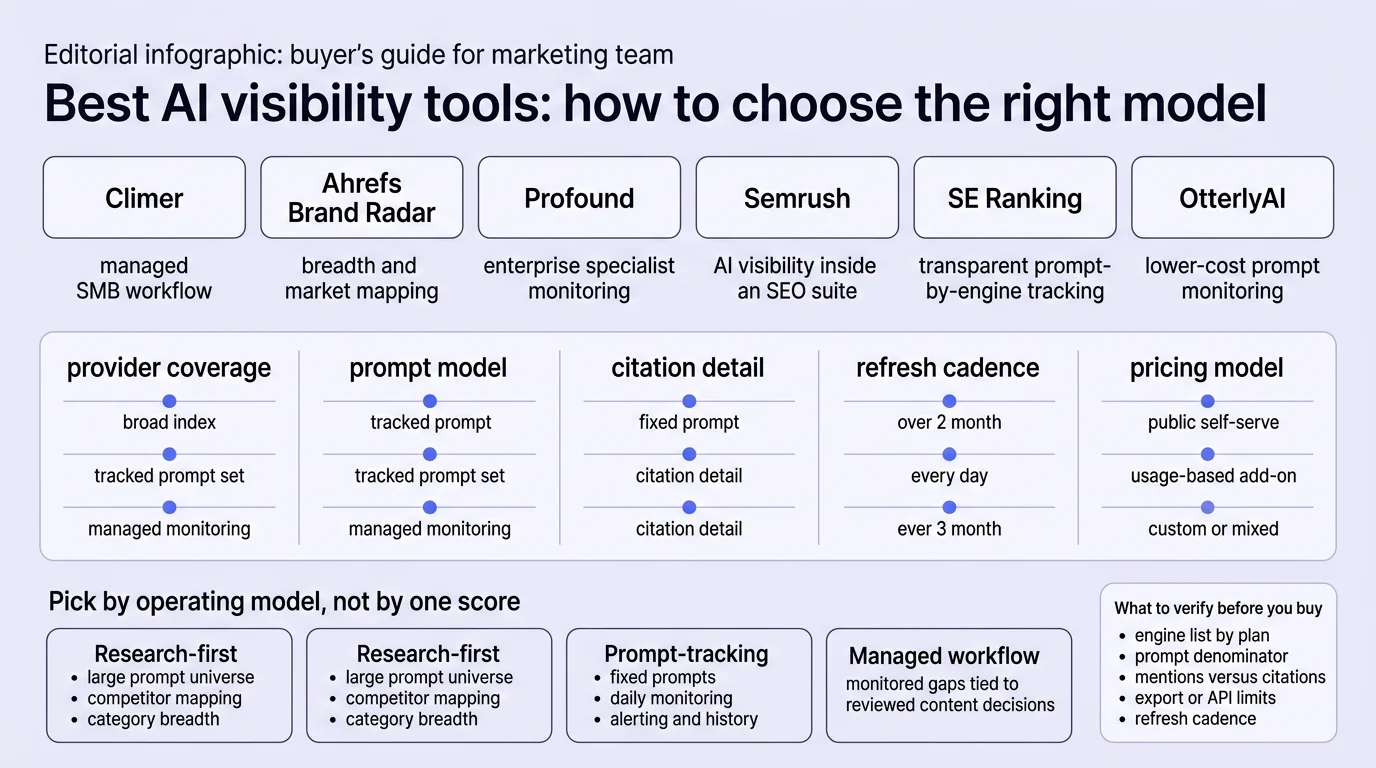
- Choose Ahrefs Brand Radar if you want the broadest published search-backed prompt database for top-of-funnel research and competitive visibility mapping.
- Choose Profound if you want a specialist answer-engine platform with deeper enterprise coverage, agent analytics, and room for custom rollout.
- Choose Semrush AI Visibility Toolkit if you already work inside Semrush and want AI visibility next to prompt research, brand performance, and site-audit checks.
- Choose SE Ranking's AI Search add-on if you want a clear prompt-by-engine cost model and already run SEO inside SE Ranking.
- Choose OtterlyAI if you want a lower-cost prompt tracker with straightforward daily monitoring and published self-serve pricing.
- Consider Climer if you are an SMB that wants AI visibility monitoring tied to a managed search-content workflow rather than another self-serve dashboard.
Comparison method#
I verified this comparison against each vendor's public product or pricing materials on August 19, 2026. I weighted six criteria:
- provider coverage;
- prompt sampling model;
- mention and citation evidence;
- refresh cadence and monitoring model;
- exports, APIs, or workflow fit; and
- published pricing.
I mark limits or export rules as undisclosed when a vendor omits them from its public pages. Many tools also compress different systems into one score. For help reading that score, use AI visibility score: what it measures, hides, and cannot prove.
Comparison table#
| Tool | Best fit | Coverage and sampling model | Evidence you can inspect | Published pricing |
|---|---|---|---|---|
| Climer | SMB teams that want a managed workflow | Climer monitors AI-answer visibility and keeps Google evidence separate from AI-answer evidence. It is built around recurring planning and reviewed content decisions, not a self-serve prompt warehouse. | Prompt-level visibility inputs, observed gaps, and reviewed content decisions inside a managed loop | Starter $49 per month; Growth $99 per month |
| Ahrefs Brand Radar | Teams that want breadth first | Prebuilt search-backed prompt database across AI Overviews, AI Mode, ChatGPT, Copilot, Gemini, Perplexity, and Grok, plus custom prompts | Brand mentions, cited pages and domains, competitive benchmarking, custom prompt tracking, AI share of voice | Brand Radar starts at $199 per month; custom prompt packages start at $50 per month |
| Profound | Enterprise and specialist GEO teams | Daily prompt monitoring with plan-based response volumes and published support for broader answer-engine coverage | Answer Engine Insights, prompt volumes, exports, agent analytics, and broader enterprise rollout options | Starter $99 per month, Growth $399 per month, billed yearly; Enterprise custom |
| Semrush AI Visibility Toolkit | Existing Semrush users | Daily AI analysis and prompt research, plus tracked prompts and brand performance reports | AI Visibility Score, competitor research, prompt research, prompt tracking, brand sentiment, AI search site audit, CSV export | $99 per month |
| SE Ranking AI Search add-on | SEO teams that want a simple usage model | Prompt-by-engine checking across AI Overviews, AI Mode, ChatGPT, Perplexity, and Gemini | Brand mentions, domain links, prompt-level rankings, AI responses, competitor comparisons | Starts at $89 per month for 200 checks, or $71.20 on annual billing |
| OtterlyAI | Smaller teams that want lower entry cost | Prompt library tracked across ChatGPT, Google AI Overviews, Perplexity, and Microsoft Copilot, with extra add-ons for Claude, Google AI Mode, and Gemini | Brand visibility, prompt monitoring, agent analytics, API and MCP access on higher plans | Lite starts at $29 per month |
The sampling model sets the denominator#
Engine logos show coverage. The sampling model tells you which prompts contribute to the result.
Ahrefs Brand Radar emphasizes breadth#
Ahrefs Brand Radar publishes the largest prompt dataset in this comparison for large-scale discovery work. Ahrefs says 474 million prompts power the product each month and publishes counts for AI Overviews, AI Mode, ChatGPT, Copilot, Gemini, Perplexity, and Grok. You can add custom prompt packages to the base Brand Radar subscription.
Use Ahrefs to research:
- current brand presence;
- topics that drive mentions or citations;
- competitors across a large AI-search sample; and
- cited pages and domains.
A large prebuilt index serves discovery. A small business that cares about ten or twenty commercial prompts may need a shorter decision set and a workflow for acting on it.
SE Ranking and Otterly make the denominator easier to understand#
SE Ranking's AI Search add-on publishes a simple cost model: one check equals one prompt on one AI platform. Tracking one prompt across all five supported engines uses five checks. Agencies and mid-market teams can map that unit to the number of prompts they monitor.
OtterlyAI takes a prompt-first approach. Its pricing page frames plans around search prompts, scheduled tracking, and a defined engine list. The model suits teams that review a fixed prompt set each week.
Semrush sits between suite workflow and AI monitoring#
Semrush's AI Visibility Toolkit blends prompt monitoring with suite workflow. The public documentation says the $99 monthly plan includes 300 daily queries in AI Analysis reports, 1,000 daily queries in Prompt Research, 25 prompts for Prompt Tracking, AI Search Checks in Site Audit for up to 100 pages, and 10 CSV exports per day.
Semrush suits teams that use it for classic search and want:
- AI prompt research beside keyword research;
- daily tracked prompts without buying a separate enterprise platform; and
- technical checks that sit close to existing SEO work.
Semrush treats AI visibility as one workstream inside a broader SEO stack. Teams that need answer-engine monitoring as their main operation may want a specialist product.
Profound aims higher up-market#
Profound's pricing page now shows public plan structure instead of a pure contact-sales wall. It lists a Starter plan at $99 per month, Growth at $399 per month, and Enterprise with tailored pricing. The same page also publishes plan-based response volumes, daily prompt frequency, CSV and JSON exports, and agent analytics.
Profound is a specialist option in this set. Its public materials span:
- Answer Engine Insights;
- prompt volumes;
- agent analytics for AI-sourced traffic and attribution;
- broader answer-engine capability, including ChatGPT, Perplexity, Google AI Mode, Gemini, Copilot, Grok, DeepSeek, Claude, and AI Overviews; and
- enterprise services such as SSO and custom rollout.
Profound suits larger teams that care about governance, attribution support, and wider answer-engine coverage. An SMB with a short prompt list and a content plan may not need the full product.
Mentions and citations matter more than the headline score#
Useful products expose the evidence beneath a blended score.
On the public pages reviewed for this comparison:
- Ahrefs emphasizes cited pages and domains behind AI visibility.
- SE Ranking breaks visibility into brand mentions, domain links, or both, and shows the prompts and citations behind those results.
- Semrush layers brand mentions, sentiment, prompt research, and prompt tracking into one toolkit.
- Otterly positions itself around tracked prompts and brand visibility across named engines.
- Profound pairs answer-engine visibility with attribution and wider enterprise reporting.
A dashboard earns its place when it answers concrete questions:
- The prompts and engines that changed.
- Did our brand get mentioned, cited, or both?
- The page or third-party source the answer cited instead.
- Did the sampled visibility change line up with any qualified visits?
A score cannot support a decision when the product hides those answers.
Refresh cadence must fit your workflow#
Each product supports a different recurring job.
Semrush publishes daily updates for Visibility Overview, Competitor Research, Prompt Research, and Prompt Tracking, with weekly updates for Brand Performance. SE Ranking frames its product around tracked prompts and historical visibility change. Otterly publishes daily tracking on its higher plans. Profound publishes daily prompt frequency on the plans shown in its pricing table. Ahrefs combines large indexed coverage with custom prompt tracking rather than a single narrow daily tracker story.
That leads to three distinct operating models:
1. Research-first platforms#
These help you map the market before you choose a fixed monitoring set.
Ahrefs is the clearest example.
2. Prompt-tracking platforms#
These help you monitor a defined set of prompts and watch for movement.
SE Ranking and Otterly focus on this model. Semrush also fits when Prompt Tracking becomes the main use case.
3. Managed workflow systems#
These help you use visibility evidence to decide what content or page changes deserve review and publication.
Climer fits here by tying monitored visibility gaps to a recurring content operation for small and medium-sized businesses.
Match the product to the team#
Strong fit for enterprise monitoring#
Profound fits enterprises that need broad answer-engine coverage, agent analytics, exports, SSO, custom rollout, and tailored pricing.
Ahrefs Brand Radar fits larger teams that value breadth, category research, and competitive mapping through a large search-backed prompt corpus.
Strong fit for specialist GEO teams#
Profound and Ahrefs Brand Radar serve specialist teams through different models.
- Choose Profound if your team wants a platform centered on answer-engine operations and reporting.
- Choose Ahrefs if your team wants the broadest public prompt universe and quick top-down research.
SE Ranking suits teams that use its SEO stack and want prompt-by-engine monitoring with a transparent usage model.
Strong fit for a managed SMB workflow#
Consider Climer when you need to keep the work moving each month without building a GEO team. Climer monitors AI-answer visibility, keeps Google and AI evidence separate, and uses observed gaps as an input to content decisions that teams can review. Self-serve monitoring software leaves that operating work to the buyer.
Semrush is the better fit for SMBs that already have an in-house operator and want AI visibility inside a familiar suite.
OtterlyAI offers a low-cost fit for teams that need prompt tracking and can handle the remaining work.
Public product pages leave buying questions open#
Vendors reserve some material details for sales calls, help docs, or product UI.
The most common public-page gaps are:
- unclear export limits or API access by plan;
- unclear treatment of mentions versus direct citations;
- unclear benchmark methodology behind visibility scores; and
- unclear differences between prebuilt prompt datasets and custom tracked prompts.
Treat those gaps as buying criteria. If you are about to commit budget, ask the vendor for:
- the exact engine list by plan;
- whether tracked prompts refresh daily, weekly, or on demand;
- whether exports place mentions, citations, and position in separate fields;
- whether referral or attribution data is first-party, integrated, or inferred; and
- what changes the score denominator over time.
Choose the operating model before the dashboard#
An engine logo wall makes these tools look interchangeable while their workflows differ.
Ahrefs emphasizes breadth. Profound offers specialist enterprise depth. Semrush keeps AI visibility inside a broader SEO suite, while SE Ranking publishes a clear prompt-by-engine budget model. Otterly offers a low-cost entry point. Climer ties a monitored visibility loop to managed content work for SMBs that want the operation handled with them.
Choose the operating model your team can sustain, then compare the score, prompts, citations, exports, and price.