Guide · AI search visibility and GEO
AI search referral traffic: how to measure visits without overstating attribution
Learn how to identify AI assistant referrals, separate them from mentions and citations, and judge whether small volumes are producing useful visits or conversions.
Climer team · August 17, 2026 · 9 min read
AI search referral traffic gives you partial evidence of assistant-sourced visits. Count the visits you can verify, inspect their landing pages and outcomes, and report that traffic apart from mentions and citations.
For the wider operating model, read Generative engine optimization: a practical operating model for AI answers. This guide shows you how to identify observable AI referrals, find attribution gaps, and interpret small numbers with the limits intact.
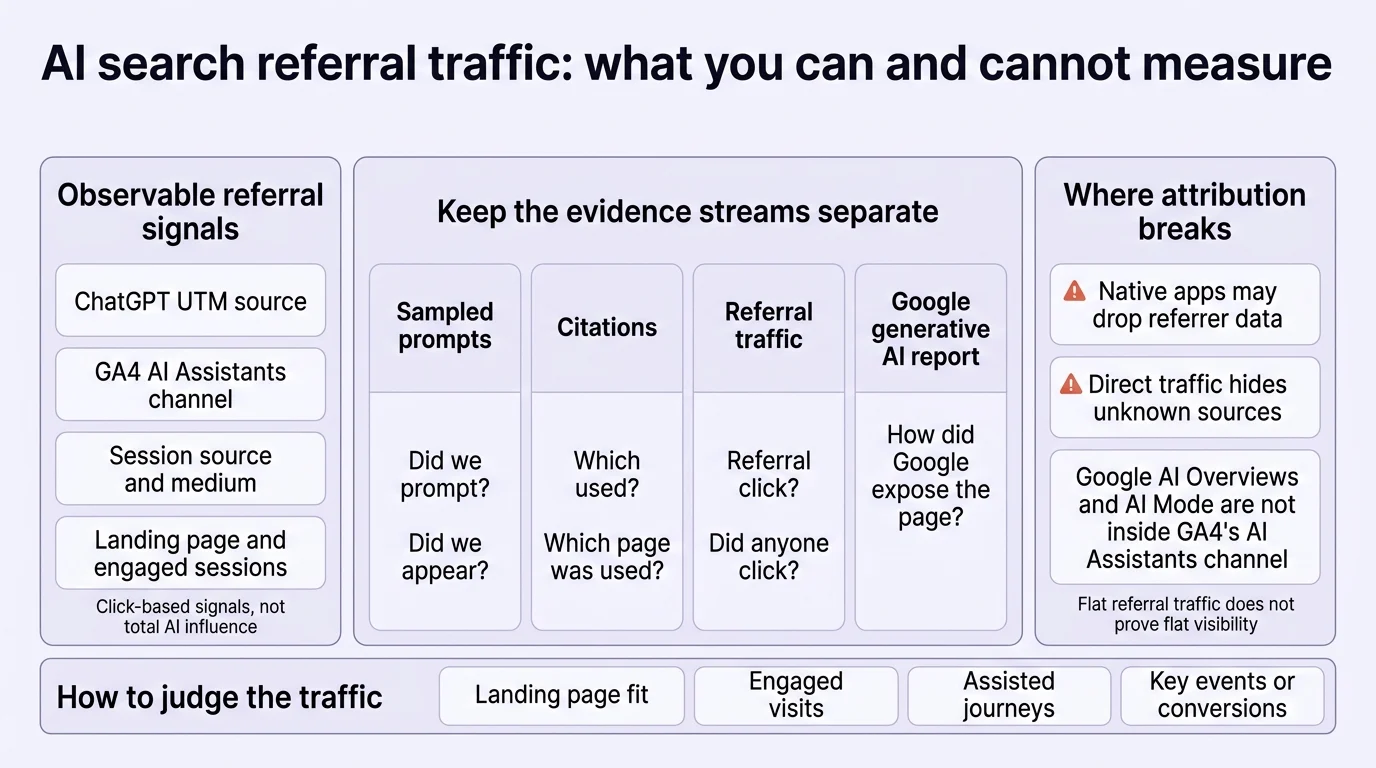
AI search referral traffic measures clicks, not total influence#
An AI referral reaches your site after someone clicks a link inside an AI-generated answer, search result, or assistant interface. Analytics can record the visit when the click carries enough source information.
Other AI discovery outcomes leave different signals:
- A user can read an answer, remember your brand, and visit later through direct traffic or branded search.
- A platform can mention your company and omit a link.
- A platform can cite your page inside the answer while sending very few clicks.
- A native app can drop the referrer data your analytics setup expects.
Give AI referrals their own column so they do not become a proxy for total AI visibility.
| Evidence stream | Best question to ask | What it cannot prove |
|---|---|---|
| Prompt checks and visibility sampling | Did we appear in the tested answers? | Whether anyone clicked |
| Citations and linked sources | Which page or domain did the answer use as a source? | Whether the source produced traffic or revenue |
| AI search referral traffic | Which assistant visits reached the site? | Total AI-driven discovery or assisted demand |
| Google Search Console generative AI report | How did Google AI Overviews and AI Mode expose our pages? | Cross-provider traffic or cross-provider visibility |
A combined number conceals whether visibility, citation quality, clickability, or attribution caused the change.
The source signals you can trust today#
Measurement guides lead the live results for ai search referral traffic. Searchers need a way to capture observable visits in analytics and preserve the gaps in attribution.
Start with three source signals.
1. ChatGPT can send explicit referral tagging#
OpenAI's Publishers and Developers FAQ, updated July 30, 2026, says publishers who allow OAI-SearchBot can track referral traffic from ChatGPT and that ChatGPT includes the utm_source=chatgpt.com parameter in referral URLs from ChatGPT search results.
The parameter gives you a concrete signal to find in analytics:
utm_source=chatgpt.com- session source values tied to ChatGPT referrals
- the landing pages that those visits reach
The signal covers clicks that arrive with the tag intact. Other ChatGPT interactions remain outside this attribution path.
2. Google Analytics groups recognized assistant traffic#
Google announced a new ai-assistant medium and AI Assistants default channel on May 13, 2026 in What's new in Google Analytics. Analytics assigns them when the referrer matches a recognized AI assistant. Google's default channel group documentation says this channel excludes Google AI Overviews and AI Mode.
The exclusion explains why Search Console may show Google generative impressions while the GA4 AI Assistants channel shows few sessions. Each product measures a different surface.
3. Search Console tracks Google's generative surfaces#
Google documented its generative AI performance report in June 2026. As of August 19, 2026, Google continues to roll it out. The report covers impressions from AI Overviews and AI Mode and groups them by page, device, country, and date.
Use the report for visibility inside Google. Referral analytics records visits, while separate tools cover ChatGPT, Perplexity, Claude, and other answer systems.
Divide the work by source:
- Use Search Console for Google generative exposure.
- Use GA4 for observed assistant-sourced visits.
- Use prompt and citation monitoring for broader answer visibility.
Build a defensible measurement workflow#
Start with a workflow that records visible signals on a fixed schedule. You can add a complex attribution model when the traffic volume supports it.
Start with traffic acquisition and landing pages#
Google's campaigns and traffic sources documentation explains that Analytics uses the document referrer and UTM parameters to set source and medium values. Start in GA4's traffic acquisition and landing-page views.
For each observed AI-assistant source, pull:
- sessions or users;
- landing page;
- engaged sessions or engaged visits;
- key events or conversions; and
- trend over time.
Landing-page reports show where AI-assisted clicks arrive. Ten visits to a pricing explainer may carry more buying intent than 100 visits to a broad awareness post.
Mark the business actions that matter#
Google's key events documentation says you need to mark the events that represent meaningful business actions before Analytics can report on them as key events.
Mark actions tied to a business outcome:
- lead form submission;
- booked demo;
- trial start;
- contact request; or
- purchase.
Without marked events, you can report AI visits but cannot connect them to business outcomes.
Review the full customer journey#
AI traffic may first touch a buying guide, then lead to a return session through direct traffic, email, or branded search. Last-click reporting misses that sequence.
You can learn from the pattern without claiming causation. Review:
- the landing pages that attract assistant traffic;
- the rate of engaged sessions from those pages;
- the key-event rate for those sessions; and
- whether those pages appear often in assisted or multi-session paths inside your analytics stack or CRM.
Use those signals to decide whether a page attracts visitors who engage or return. Revenue attribution requires stronger evidence than an assistant mention.
Attribution will remain incomplete#
Observed AI referral traffic undercounts visits that arrive without usable source data.
Google says Analytics classifies a session as direct traffic when it receives no referral source information. That rule creates a blind spot for assistant traffic that arrives without a usable referrer or UTM signal.
Cloudflare documented another gap in its July 1, 2025 analysis, The crawl before the fall... of referrals. Claude's native app omits a Referer header, so Cloudflare says its crawl-to-referral ratios may overstate the gap. Cloudflare suspects other native apps omit the header too.
Expect three consequences:
- Measured assistant referrals are real, but incomplete.
- Native-app behavior can hide part of the clickstream from GA4.
- A flat referral number does not prove flat AI visibility.
Keep Google Analytics and Search Console in separate channel definitions. Search Console can show growing generative impressions while GA4 shows little AI Assistants traffic because the GA4 channel excludes AI Overviews and AI Mode.
Interpret small and volatile traffic in context#
Small numbers call for context. Compare intent, landing-page fit, and outcomes before you judge the channel.
| What you see | Safer interpretation | Next check |
|---|---|---|
| A few assistant visits to one high-intent page | Evidence that the page may support a narrow job | Check engagement and key events before trying to scale volume |
| Mentions or citations rise, but visits stay flat | The source may be visible while drawing few clicks | Review answer format, page promise, and link placement |
| A short traffic spike disappears the next week | Platform behavior or attribution may have shifted | Check referrer patterns, landing-page mix, and whether prompt visibility also changed |
| Traffic grows, but all visits land on the wrong page | The engine found you, but not through the best canonical owner | Improve or replace the page that should own the job |
Teams can overreact to a small spike or dismiss the channel after a quiet week. Use several measurement windows before you change the program.
Adobe's analytics research shows potential value in small volumes. Its 2025 holiday report, based on more than 1 trillion visits to U.S. retail sites, reported a 693.4% year-over-year increase in AI-driven retail traffic during the holiday season. A related Adobe Commerce analysis found a 31% higher conversion rate for those AI referrals than for other traffic sources. In an April 16, 2026 retail update, Adobe reported 393% year-over-year growth in Q1 2026 AI traffic to U.S. retail sites and a 42% conversion advantage in March. The retail data applies to a specific industry. It shows why marketers should review intent and conversions alongside traffic volume.
Keep referral traffic separate from mentions and citations#
Referral traffic records visits from an answer surface. Use other evidence to measure:
- mentions in answers that sent no click;
- how often your brand appeared across sampled prompts;
- citations to a third-party review site or directory instead of your own page; or
- changes in Google generative exposure apart from assistant referrals.
If you need the measurement model behind prompt sampling and score reporting, use AI visibility score: what it measures, hides, and cannot prove. If you need the Google-specific surface mechanics, use AI Overviews in search: what changes for visibility, citations, and clicks.
Assign one job to each stream:
- use sampled prompts and citations to understand answer visibility;
- use Search Console to understand Google generative exposure;
- use referral analytics to understand observed visits and downstream actions.
Read the streams together, but do not substitute one for another.
Climer's role#
Climer monitors AI-answer visibility and keeps Google and AI evidence separate. Referral traffic remains a distinct evidence stream. Climer connects observed visibility gaps to content decisions that teams can review, without claiming comprehensive analytics attribution or a shipped analytics integration.
AI search referral traffic provides one of the few direct outcome signals available to marketers. Treating it as a complete ledger of AI discovery would hide mentions, citations, and unattributed visits.
Measure verified visits and document the blind spots. Landing-page fit, engagement, assisted journeys, and conversions tell you more than session count about the value of the traffic.