Guide · AI search visibility and GEO
Answer engine optimization: how to design content for direct answers
Learn what answer engine optimization means, which answer surfaces it covers, and how answer extraction changes page structure, evidence, and measurement.
Climer team · August 16, 2026 · 9 min read
Answer engine optimization makes a page easy to extract, cite, and reuse when a search product puts an answer before its list of links.
Publishers practiced forms of AEO before the current label appeared. As of August 19, 2026, definition-first guides lead the live results for answer engine optimization in the United States, United Kingdom, and Australia. Each market also shows a Google AI Overview above the organic results. Marketers want to understand AEO as a content-design discipline they can use.
For the broader operating model, read Generative engine optimization: a practical operating model for AI answers. This guide focuses on answer extraction and the page changes that help an engine reuse an answer block.
AEO starts with page design#
Google's current guide to optimizing for generative AI features on Google Search defines the term through two points.
- AEO and GEO are labels people use for AI-search visibility work.
- From Google's perspective, this is still SEO because its generative AI features rely on core Search ranking and quality systems.
AEO gives teams a useful label for work that improves answer extraction. Claims about technical loopholes, special schema recipes, or guaranteed quotes go beyond the evidence.
Google says its AI features use retrieval-augmented generation and query fan-out. The system retrieves relevant pages, examines passages, and may issue related searches while composing the response. Write each page so an engine can lift a useful passage while preserving its meaning.
AEO spans direct-answer surfaces and AI answers#
Early AEO work focused on direct-answer search features. Google's featured snippets documentation describes boxes that show a snippet first and may appear inside People Also Ask results. Featured snippets established a focused form of answer extraction.
The term now covers a wider set of answer surfaces. Google's AI features documentation says AI Overviews and AI Mode surface relevant links while generating an answer and may use query fan-out to gather supporting pages. OpenAI's crawler documentation says ChatGPT's search features use OAI-SearchBot to surface websites.
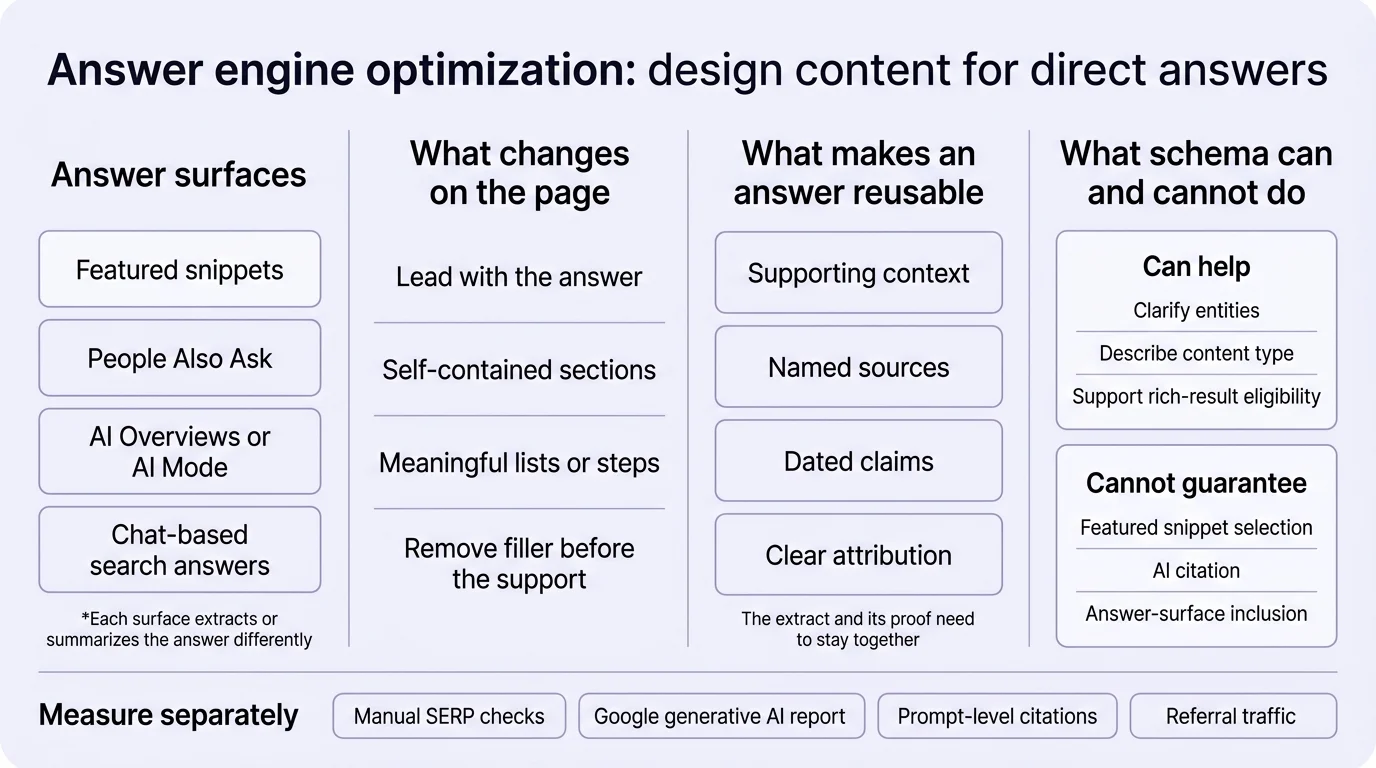
Use this surface map:
| Surface | What gets extracted | What that means for the page |
|---|---|---|
| Featured snippets and related direct-answer boxes | One short passage or list | Put the answer near the top in clear prose |
| People Also Ask style follow-up results | A concise answer to a narrower sub-question | Subheadings need to own distinct follow-up questions |
| AI Overviews and AI Mode | Multiple supporting passages, links, and related details | The page needs an answer block plus enough support to stay credible |
| Chat-based search answers | Summaries or recommendations with possible citations | The page needs extractable claims and surrounding evidence the system can trust |
Across these surfaces, write each passage so an engine can reuse it without stripping away the context that keeps it accurate.
Structure pages for direct-answer extraction#
A page built for blue-link clicks may delay the answer. A page built for extraction puts the answer near the top and follows it with support.
Make four changes.
Lead with the exact answer#
Use one to three sentences to define the term, resolve the decision, or explain the step before the page widens out.
"Be concise" gives writers little direction. Put the useful answer where a search engine can identify it before five setup paragraphs get in the way.
For example:
- weak pattern: a long introduction about how search is changing;
- useful pattern: a direct definition with its scope and main limitation.
Google's featured snippets documentation says publishers cannot mark their own pages as featured snippets. Google chooses the page it considers a good answer for the request, so clear visible content carries the work.
Make each section self-contained#
Answer engines may need one section rather than the full page. Help them reuse a section by meeting four conditions:
- the heading makes a clear promise;
- the first sentence fulfills that promise;
- the next sentences support or qualify the answer; and
- the section does not depend on vague references like "this," "that," or "as discussed above."
AEO favors headings that map to follow-up questions and sections that can stand on their own.
Keep lists and steps meaningful#
Use a list when the query expects one and a numbered sequence when order affects the result. Bullets add little to a topic that calls for a connected explanation.
Choose a structure that matches the answer:
- definition plus scope;
- decision criteria;
- comparison table;
- numbered process;
- problem, cause, and fix;
- short claim followed by evidence.
A matching structure helps readers scan the answer and helps engines extract it.
Cut filler that separates the answer from the support#
Remove commodity intros, repeated definitions, and vague transitions. They add distance between the query and the supported answer.
Supporting context matters as much as the answer block#
AEO advice often focuses on the extract and neglects its support. The answer block attracts attention, while the surrounding context gives readers and systems reasons to trust it.
Give the system inspectable support for the answer:
- a named method;
- a current date for claims that change;
- an example that grounds the advice;
- a comparison with explicit criteria;
- a source the reader could verify; or
- a clear statement of limits.
Google's AI optimization guide returns to unique, valuable, non-commodity content. Answer engines need a useful passage and evidence that supports it.
Build the page in this order:
- Put the answer near the top.
- Add the support underneath it.
- Preserve the context needed to keep the answer accurate when lifted.
Many AEO pages omit the middle step and leave an extractable sentence without proof.
Attribution changes the content job too#
Classic SEO often treats the click as its main success signal. Answer surfaces may show part of your answer before the user chooses whether to visit, so AEO requires a wider view.
That changes the page's attribution job in two ways.
First, your claims need to remain understandable outside the full-page context. If the answer engine quotes or summarizes one section, readers should still recognize the company, product, category, and core claim.
Second, the page should make the source relationship easy to inspect. Named studies, product pages, documentation, pricing dates, and visible authorship help humans and systems connect the extracted statement to a source.
For informational queries, a direct-answer page gives the engine an attributable passage that a vague landing page may lack.
Use schema for interpretation#
Publishers often overstate schema's role in AEO.
Google's structured data introduction says Google uses structured data to understand page content and gather information about the page and the broader web. Structured data can clarify the subject and make a page eligible for certain rich results.
Google's general structured data guidelines set the boundary. Valid markup does not guarantee that a feature will appear. Google also says a structured-data manual action affects rich-result eligibility rather than ordinary web ranking.
Use schema within four limits:
- schema can help machines interpret entities and content types;
- schema can support eligibility for some search features;
- schema does not make Google choose your page as the answer;
- schema does not guarantee featured snippets, AI citations, or AI Overview links.
The page still needs clear visible content. Google's guidelines say the structured data should represent the main visible content and exclude hidden material.
Use structured data when it matches the visible page. Google still controls answer selection.
Measure extraction through separate evidence streams#
Answer extraction adds new post-publication measurements.
A classic ranking with no answer-surface presence may expose a weak extraction structure. Citations without visits show exposure with limited commercial value. Assistant referrals prove that visits occurred, but cannot explain why the citation changed.
Keep the evidence streams separate.
| Evidence stream | What it tells you | What it does not prove |
|---|---|---|
| Manual SERP checks for featured snippets, People Also Ask, or cited links | Where the page appears as a named answer source | Durable performance across all runs or users |
| Google's generative AI performance report | How the page performs in Google's AI features | AI Overviews alone, because the report also includes AI Mode |
| Prompt-level citation checks across answer engines | Whether the page or brand appeared in a sampled prompt set | Full market share or business impact |
| Referral analytics and assistant-tagged visits | Whether answer surfaces sent traffic | Citation cause or exposure on other surfaces |
Google's generative AI performance report help page says the report includes impressions from AI Overviews and AI Mode. OpenAI's publishers FAQ says publishers can track ChatGPT search referrals, and ChatGPT includes utm_source=chatgpt.com in referral URLs.
Run this AEO loop:
- inspect the live answer surface;
- improve the answer block and its support;
- recheck citations and source usage;
- review Google generative AI reporting in its own view; and
- check whether any assistants sent qualified visits.
AEO, SEO, and GEO each own a different part of the work#
AEO covers a narrower part of the work than SEO or GEO.
- SEO owns crawlability, indexing, canonical control, demand mapping, ranking, and page performance in classic search.
- AEO owns answer-format and extractability inside direct-answer surfaces.
- GEO owns the broader cross-provider operating model for AI answer visibility, prompt sampling, citations, and measurement.
SEO makes the page retrievable and eligible. GEO gives the team a way to compare Google AI features, broader answer-engine citations, and referral traffic across providers. AEO depends on both.
If you need the broader implementation sequence, use AI search engine optimization: a practical implementation playbook. If you need the Google feature mechanics, use AI Overviews in search: what changes for visibility, citations, and clicks.
Climer's role#
Climer helps SMB teams turn answer-surface observations into content decisions they can review while preserving each evidence stream.
Climer monitors AI-answer visibility, keeps Google and broader AI evidence separate, and uses observed gaps as an input to content decisions. Answer engines retain control over extraction, and Climer makes no claim of exhaustive provider coverage or guaranteed results from a schema tweak.
Good answer engine optimization lets a search product lift the core answer, preserve its meaning, and find enough evidence to trust it. The same qualities help human readers understand the page.