Guide · AI search visibility and GEO
ChatGPT SEO: what publishers can influence
Learn which parts of ChatGPT search visibility a publisher can control, how to measure mentions and citations, and which claims about ChatGPT SEO still lack evidence.
Climer team · August 19, 2026 · 8 min read
ChatGPT SEO makes your pages easier for ChatGPT search to discover, cite, and represent without distortion. Publishers control their site quality, crawler access, and measurement. OpenAI controls ChatGPT's internal ranking logic.
The live results for chatgpt seo mix guidance on appearing in ChatGPT answers with guidance on using ChatGPT for SEO work. As of August 19, 2026, chatgpt.com, Reddit, Forge and Smith, SEO.com, and Semrush lead the saved US, UK, and Australia samples behind this brief. Marketers want to know which publisher-side changes can influence ChatGPT answers.
For the broader operating model, read Generative engine optimization: a practical operating model for AI answers. For a cross-platform view, use LLM SEO: controllable work, weak signals, and false promises. This guide covers ChatGPT search.
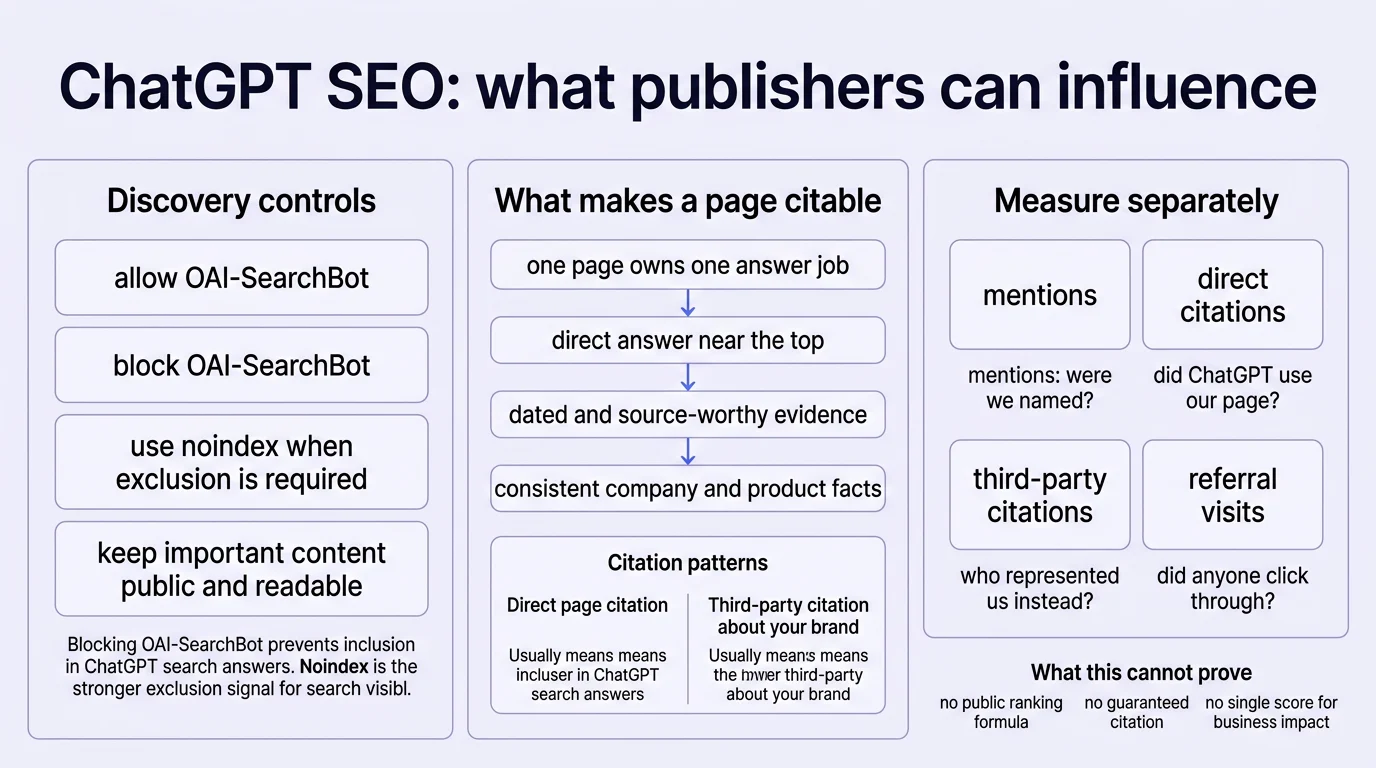
ChatGPT SEO starts with discovery and citation eligibility#
OpenAI's publisher guidance covers fewer controls than many ChatGPT SEO pitches claim.
The OpenAI crawler documentation says ChatGPT's search features use OAI-SearchBot to surface websites. Sites that opt out cannot appear in ChatGPT search answers, though ChatGPT may still show them as navigational links. The Publishers and Developers FAQ adds that OpenAI may receive a disallowed URL from a third-party search provider or another page. If relevance signals support the URL, ChatGPT may show its title and link as a navigational result. OpenAI points publishers who want to prevent that result to noindex.
The controls have distinct effects:
| Setting or condition | What it changes in ChatGPT search |
|---|---|
Allow OAI-SearchBot | Makes the page eligible to appear in ChatGPT search answers |
Block OAI-SearchBot | Prevents inclusion in ChatGPT search answers, though a navigational link may still appear |
Add noindex | Signals that the page should not appear in search results |
| Keep the page public | Lets ChatGPT search and other systems inspect the visible content |
Check whether OpenAI can surface the page before you test prompts.
OpenAI publishes a limited set of mechanics#
OpenAI's public documentation confirms four mechanics.
- The ChatGPT Search help article says ChatGPT may search the web when a question would benefit from current sources.
- The same article says ChatGPT search responses may include inline citations or a Sources panel with cited sources and other relevant links.
- The help article also gives a concrete example of prompt rewriting: if a user asks for restaurants and has location or memory context, ChatGPT may reformulate the search into a more targeted query.
- The October 31, 2024 product launch post says ChatGPT search connects users with web sources and uses links to relevant sites inside the conversation.
OpenAI leaves key ranking details unpublished:
- no public ranking formula for ChatGPT search;
- no public promise that one page format guarantees citation;
- no public claim that ChatGPT uses one stable query path for every prompt;
- no public evidence that a single rewrite or markup change produces a durable citation lift.
Build the operating model around sampled evidence because OpenAI does not expose those details.
Control access, page quality, and entity clarity#
Site quality and page quality provide the strongest publisher-controlled inputs.
1. Keep one page assigned to one answer job#
ChatGPT search can rewrite or narrow a prompt before searching. Clear page ownership gives the system a focused source for the rewritten query.
A page is easier to reuse in a cited answer when it has:
- one primary question or decision to resolve;
- a direct answer near the top;
- headings that map to common follow-up questions;
- a clear boundary between definition, comparison, and product pitch; and
- enough support that the answer still makes sense when the cited section is read on its own.
If three pages each half-answer the same question, ChatGPT may choose another domain with one complete answer.
2. Make the page worth citing#
Citation depends on source quality. A commodity page gives ChatGPT little reason to choose your site.
Improve source quality through:
- dated claims when product details, pricing, or policies can change;
- named methodology for any benchmark, framework, or comparison;
- direct definitions before abstract explanation;
- examples tied to the real market or workflow;
- specific criteria on comparison pages; and
- explicit limits where the evidence is incomplete.
ChatGPT compresses answers. Put a supported answer near the top so the system can reuse it without crossing generic setup.
3. Tighten the entity around the page#
ChatGPT may represent your brand through a directory, review page, Reddit thread, news article, or partner page.
Support entity clarity across those sources:
- keep company name, product names, and category description consistent;
- make about, contact, product, and service pages easy to reconcile;
- fix stale or conflicting claims on major third-party profiles; and
- strengthen the pages that should be the canonical sources for commercial and educational queries.
The direct-versus-third-party distinction is useful here.
| Citation pattern | Possible meaning | Next action to consider |
|---|---|---|
| ChatGPT cites your page | ChatGPT found your page usable for the answer | Improve and preserve that page |
| ChatGPT mentions your brand and cites a third party | ChatGPT trusts the surrounding web more than your page for this prompt | Improve the owned page and review the third-party evidence |
| Neither your brand nor your page appears | The source is missing, weak, or outranked by stronger alternatives | Check access, page ownership, evidence, and off-site corroboration |
Citation patterns reveal more than a claim that your brand is "ranking" in ChatGPT.
A repeatable ChatGPT SEO test loop#
ChatGPT can rewrite queries and vary its cited sources, so treat one observed answer as a sample.
Use a fixed prompt set tied to real jobs:
- category definition prompts;
- comparison prompts;
- problem-solution prompts;
- branded prompts tied to a clear reason for your company to appear; and
- local prompts when geography affects the answer.
For each prompt, record:
- date;
- locale or market when relevant;
- exact prompt;
- whether ChatGPT mentioned your brand;
- whether it cited your page;
- whether it cited third-party pages instead;
- whether the answer was accurate in tone and facts; and
- whether any visit reached your site afterward.
OpenAI's FAQ gives one concrete traffic signal: ChatGPT search referrals include utm_source=chatgpt.com, so analytics can track tagged visits. Referral traffic covers one part of visibility. A prompt may mention you without a click, and a visit may land on the wrong page.
If you need the traffic boundary in more detail, use AI search referral traffic: how to measure visits without overstating attribution.
Diagnose the sampled answers#
Use the test loop to diagnose the change behind each appearance.
The answer mentions you without a citation#
The pattern can signal weak source ownership. ChatGPT recognizes the brand while another domain provides stronger support.
Check:
- whether the relevant owned page answers the exact prompt family;
- whether the answer appears near the top of the page;
- whether the supporting facts are current and specific; and
- whether a third-party page is easier to interpret than your own page.
The answer cites the wrong page on your site#
Conflicting page boundaries can cause this pattern.
Common fixes include:
- splitting one overloaded page into clearer owners;
- consolidating thin variants that compete for the same job;
- improving the heading structure so the right section is easier to extract; and
- strengthening the page that should be the canonical answer.
The answer contains an error#
Correcting a false or stale summary can create more business value than adding another mention.
Review:
- whether your own core pages still carry outdated claims;
- whether third-party pages repeat those outdated claims;
- whether readers can verify product, pricing, or location facts; and
- whether the query should resolve to a commercial page instead of a generic resource.
Set honest expectations#
You can improve discovery eligibility, the usefulness of the right owned page, and the quality of your public information. You can also measure sampled mentions, citations, and referrals.
The evidence supports no published ranking formula or citation guarantee. One test run cannot prove a durable gain, and ChatGPT behavior does not transfer to Google, Perplexity, or every other assistant. Report mentions, citations, and traffic as separate signals under the same evidence standard you use for other search claims.
Climer's role#
Climer supports the operating part of ChatGPT SEO by monitoring sampled AI-answer visibility, keeping Google and broader AI evidence separate, and turning observed gaps into content decisions that teams can review. OpenAI retains control of ChatGPT, and Climer makes no claim of exhaustive provider coverage, guaranteed citations, or a universal visibility score.
Pick one prompt family with a clear reason to include your brand. Confirm that ChatGPT can discover the right page, improve its answer quality, inspect the cited source, and measure referrals in their own report. Those checks keep the work within the evidence publishers can control.