Guide · AI search visibility and GEO
LLM SEO: controllable work, weak signals, and false promises
Learn what LLM SEO means in practice, which cross-platform inputs you can influence, and which popular tactics lack current evidence.
Climer team · August 18, 2026 · 10 min read
LLM SEO is market shorthand for improving how AI answers discover, cite, and describe your brand and pages. The work spans several answer systems, each with its own retrieval and ranking mechanics.
As of August 19, 2026, definition-plus-tactics guides, a Google AI Overview, and follow-up questions about the difference between LLM SEO and GEO dominate the live US results for llm seo. SEO practitioners need to separate durable publishing work from advice they cannot verify.
For the broader operating model, read Generative engine optimization: a practical operating model for AI answers. This guide covers cross-LLM discovery mechanics, publisher controls, and claims that lack evidence.
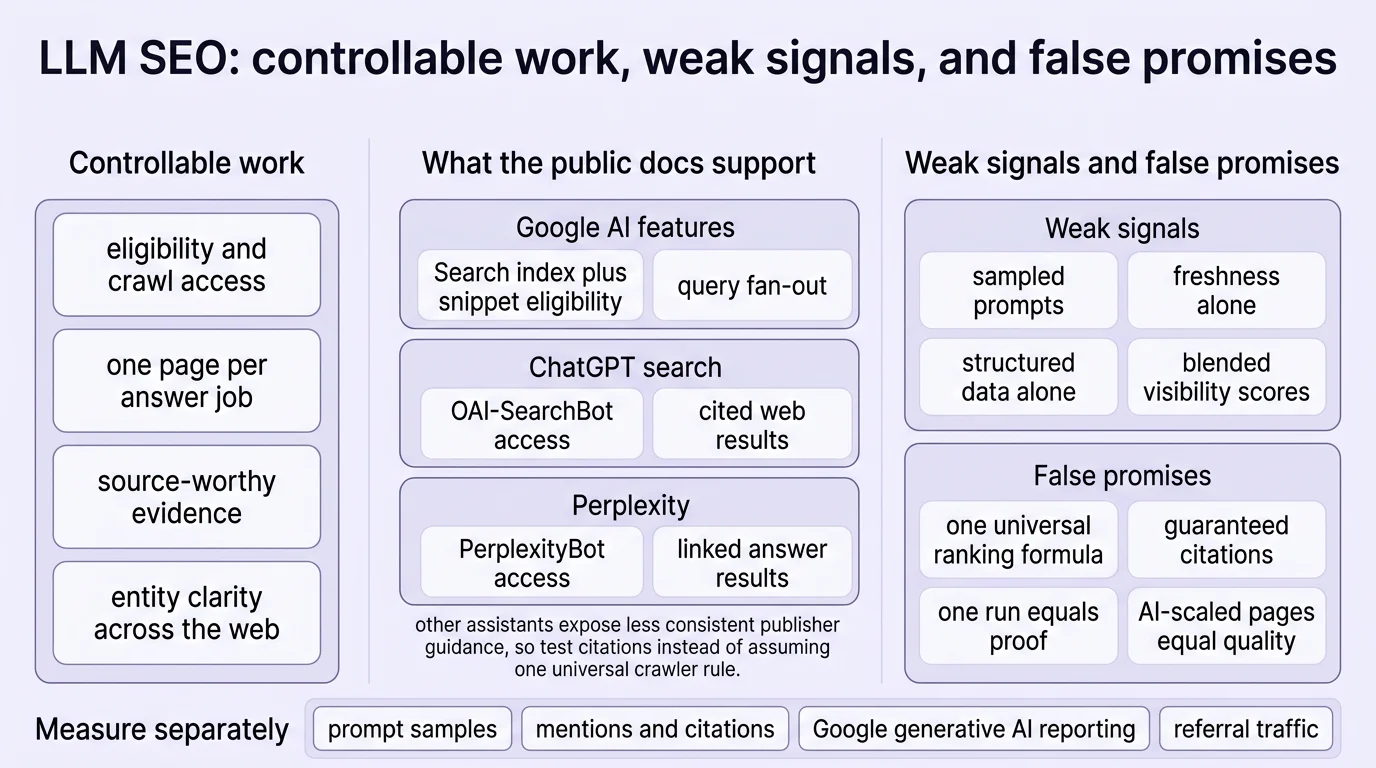
LLM SEO covers cross-platform source work#
The term has market momentum. Current evidence describes several changing systems rather than one stable optimization target.
Google's current guide to optimizing for generative AI features on Google Search applies SEO best practices because Google builds its generative AI features on core Search ranking and quality systems. The guide also explains retrieval-augmented generation and query fan-out.
The research record contains narrower findings than many vendor explainers suggest.
- The 2024 paper GEO: Generative Engine Optimization showed up to 40% visibility gains inside its benchmark setting, where the source was already in the candidate set.
- The 2025 paper Generative Engine Optimization: How to Dominate AI Search found large differences across AI search systems in freshness, language stability, phrasing sensitivity, and source mix.
- The July 2026 survey Optimizing Visibility in Generative Engines describes a stochastic pipeline that publishers can observe in part. The authors found no reviewed technique with a stable, longitudinal, cross-platform causal effect on organic discovery.
Treat llm seo as cross-platform source optimization and measurement. Each platform requires its own observations.
Each platform exposes different controls#
The phrase "the LLMs" hides differences in how platforms access the web.
The providers document their controls to different degrees:
| Surface | Published mechanics | Publisher controls |
|---|---|---|
| Google AI Overviews and AI Mode | Google's AI features documentation says these experiences use pages from the Search index, require snippet eligibility, and may use query fan-out while generating the answer. | Standard SEO eligibility, indexable content, snippet controls, page quality, business or product details where relevant |
| ChatGPT search | OpenAI's crawler documentation says ChatGPT search features use OAI-SearchBot to surface websites. Its ChatGPT Search help page says ChatGPT may rewrite a prompt into one or more targeted queries and can include inline citations. | Allow OAI-SearchBot, keep pages accessible to the public, improve answer fit, inspect cited pages and referral URLs |
| Perplexity | Perplexity's crawler documentation says Perplexity search results use PerplexityBot to surface and link websites. Perplexity-User may visit a page to help answer a user question. | Allow the documented crawlers, keep pages accessible, improve source clarity and answer usefulness |
| Other assistants and model surfaces | Providers publish less consistent retrieval detail. Anthropic's current docs explain Claude web search and citations for developers but offer fewer publisher crawl controls than Google, OpenAI, or Perplexity. | Improve observable cited web sources, then test prompts under each provider's documented behavior |
"Optimize for all LLMs" gives a team no usable scope. Start with common source work, then account for each platform's access and citation mechanics.
Control the public information each platform can reuse#
Durable LLM SEO starts with public information that survives retrieval and reuse.
1. Keep the important pages eligible and accessible#
Confirm that each target platform can reach and reuse the page.
Google's AI optimization guide requires an indexed page with snippet eligibility for its generative AI features. OpenAI excludes sites that opt out of OAI-SearchBot from ChatGPT search answers, though ChatGPT may still show navigational links. Perplexity publishes crawler guidance for PerplexityBot.
Run four access checks:
- Confirm the page is indexable and crawlable.
- Confirm important content is present in visible HTML.
- Resolve duplicate URLs, weak canonicals, and redirect confusion.
- Allow the relevant crawlers for the platforms you care about.
2. Assign one page to one answer job#
Answer systems map a question to a source. One page with one clear job gives them a focused candidate.
Strong candidates have:
- a direct answer near the top;
- clear headings that map to common follow-up questions;
- a specific scope, such as definition, comparison, local decision, or how-to;
- a page boundary that does not try to define the category, sell the product, compare competitors, and answer support questions all at once.
For the implementation sequence, use AI search engine optimization: a practical implementation playbook. LLM SEO breaks down when an assistant cannot identify which page should answer a question.
3. Make the page worth citing#
The page needs to offer something better than a commodity summary.
Google's current guide calls for unique, valuable, non-commodity content. The 2026 GEO survey reaches a compatible conclusion: topical relevance and context position show the most reproducible effects, while generic heuristics fail to transfer across systems.
An SMB can improve source quality through:
- current dates on claims that change;
- named methodology for any framework, benchmark, or test;
- examples specific to the market, product, or workflow;
- comparison criteria that a buyer could inspect;
- direct definitions before abstract commentary;
- honest limits where the evidence is incomplete.
These improvements require editorial judgment tied to the source and audience.
4. Tighten entity clarity across the web#
Cross-LLM visibility depends on more than one page.
Google's AI optimization guide points site owners to product feeds, local business details, and Google Business Profiles when those facts matter. The 2025 GEO paper also found that earned media and third-party sources can carry more weight in AI search than brand-owned or social sources.
Keep your company name, product names, category description, location details, and primary claims consistent across:
- core site pages;
- product or service pages;
- about and contact pages;
- local or merchant profiles where relevant;
- credible third-party references that buyers and answer engines may inspect.
Google warns publishers against inauthentic mentions. Earn credible references that help buyers verify your claims.
Use weak signals as clues#
LLM SEO programs go off course when teams over-interpret an observed signal.
Prompt tests provide samples#
Sampled prompts show whether the answer mentions your brand, cites your page, and represents you without errors.
The sample covers its recorded provider, locale, date, and run. It cannot establish total market visibility, predict tomorrow's answer, or separate a page-update effect from run variance on its own.
OpenAI's ChatGPT Search help page says ChatGPT may rewrite prompts into targeted queries and use location context. Google's AI docs say query fan-out can trigger several related searches under one request. Treat a visible answer as a time-stamped sample.
Refresh content when facts change#
The 2025 comparative GEO paper found freshness differences across systems. Update claims when recency affects source quality.
Refresh a page after:
- pricing changed;
- a product feature or policy changed;
- a regulation or standard changed;
- a comparison page now points to stale alternatives;
- an answer engine cites the page with outdated facts.
The institutional evidence in this repository supports the same boundary. Stale content can propagate through retrieval. A fresh timestamp alone cannot prove better visibility.
Structured data supports interpretation#
Google requires no special schema markup for generative AI search and warns against over-focusing on structured data. Its mythbusting section says llms.txt neither helps nor harms visibility in Google Search.
Use structured data within these boundaries:
- structured data is useful when it matches visible content;
- structured data can support eligibility for rich results in classic Search;
- it does not guarantee AI citations or answer inclusion;
- another system may use
llms.txt; Google does not require it for LLM SEO.
Third-party scores compress too much#
A visibility score can support recurring work when the report exposes its denominator.
For a detailed breakdown, use AI visibility score: what it measures, hides, and cannot prove. A score change summarizes prompt sampling inside one tool. Business impact and cross-platform comparisons require separate evidence.
Ask for evidence behind strong claims#
Test each strong LLM SEO claim against an observable outcome.
Current evidence does not support:
- one universal ranking formula across ChatGPT, Google, Perplexity, and every other assistant;
- guaranteed inclusion or citation after a page rewrite;
- a claim that FAQ blocks, chunking, or a specific markup pattern improve citations across all providers;
- a claim that one provider run proves a visibility win;
- a single causal score that collapses prompt mentions, citations, rankings, and referral traffic;
- a claim that published AI content at scale is fine as long as it uses the latest LLM SEO vocabulary.
Google's guidance on using generative AI content on your website addresses the last point. Generative AI can help with research or structure. Scaled page production without added value can violate Google's spam policies.
A defensible LLM SEO measurement loop#
The measurement model should preserve uncertainty at the provider and prompt level.
Use a fixed prompt set tied to real jobs, then record separate evidence streams:
| Evidence stream | What to record | What it answers |
|---|---|---|
| Prompt sample | provider, locale, date, exact prompt, answer text, cited URLs | Did we appear in this sampled answer? |
| Mentions and citations | brand mention, page citation, third-party sources cited instead | Which source did the assistant trust? |
| Google generative AI reporting | Search Console impressions and clicks for Google's generative AI features | What happened in Google's own measured surface? |
| Referral traffic | sessions, landing pages, engaged visits, assisted conversions | Did any assistant send qualified visits? |
| Accuracy checks | false claims, stale claims, missing context, wrong page cited | Does the representation match the facts? |
Google says to use the Generative AI performance report in Search Console for Google's own features. OpenAI's publishers FAQ says ChatGPT search referrals include utm_source=chatgpt.com, and Google Analytics added a dedicated AI Assistants channel on May 13, 2026 for recognized assistant traffic.
Run this evidence-led loop:
- strengthen the canonical page;
- re-test a fixed prompt set;
- inspect cited pages and answer accuracy;
- review Google's reporting in its own view;
- judge whether any assistant traffic reached the right landing pages.
If you need the traffic boundary in more detail, use AI search referral traffic: how to measure visits without overstating attribution.
Climer's role#
Climer turns observed AI-answer gaps into content decisions that SMB teams can review while keeping each evidence stream separate.
Climer monitors AI-answer visibility and keeps Google and broader AI evidence separate. Answer engines retain control of inclusion, and Climer makes no claim of exhaustive provider coverage or one causal visibility score.
Use LLM SEO to keep important pages eligible, make them worth citing, tighten the entity around them, and test representative prompts. Treat the outputs as observed evidence under a defined provider, locale, date, and run.